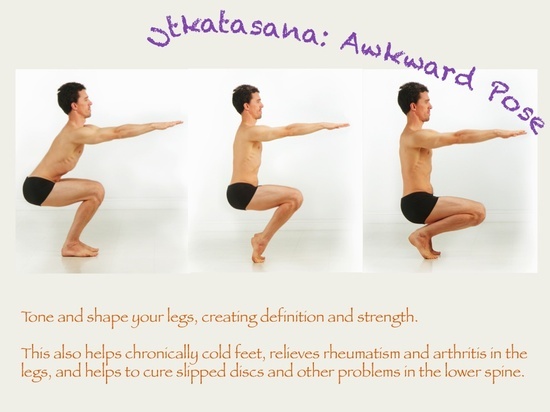
There are so many great benefits to Awkward Pose. Toned and shapely legs, relief from rheumatism and arthritis in the legs, aligned skeletal system, sciatica relief, flexibility in the toes and ankles, and relief from menstrual cramping!
There are three parts to Utkatasana, or Awkard Pose. Today we'll be exploring the first part.
Separate your feet so they are shoulder-width apart or about 6 inches between them. (The best way to measure this is to bend
down with both fists side-by-side between your feet.)
Throughout the posture, your heels stay behind the toes invisible
in the front mirror. Heels do not turn in or out but remain in perfect
alignment, so they make a perfect "number 11".
Extend your arms out and hold them up shoulder height for the
duration of the pose, never dropping them. Engage your triceps as hard as you can as you straighten your arms out in front of you,
extending from your shoulders to the tips of your fingers.
Breathe out on
the way down and in on the way up.
Maintaining a straight back and keeping the abdominals tight, begin to sit deep, bending the knees as if you're going to sit in a
chair directly behind you. Push your booty back, waaaay back. Imagine you're going to fall backwards. Push your heels into the ground while keeping your toes on the ground.
Wednesday, April 24, 2013
Wednesday, April 17, 2013
Tip of the Week: Practicing With Knee Problems
We've heard many people ask, "Is it safe to do yoga with my knee problems?"
Whether the knees are arthritic or injured, Bikram yoga will definitely help. Bikram Choudhury actually healed his knee, which was crushed by a 300 pound weight, with his guru's help doing yoga. You must move the knees to get circulation to them, and Bikram's yoga helps you do both.
Make sure to listen carefully to the alignment instructions in each posture. When you are told to keep your feet parallel in standing postures, please do so. A half inch in either direction away from parallel has its effects all the way up the knees and into the hips.
In standing balancing postures, it is also important to keep the standing foot straight and the standing knee pointing straight ahead. If your knee bows back (hyperextension) you should bring the weight forwards towards the toes so as to engage the quadriceps muscle ("lock the knee") and lift the kneecap upwards. This action brings the leg into one line and brings true strength to the knees.
When you are bending your knees in any of the standing postures, keep the knees pointed over the toes. This will ensure that the knees and hips are strengthened evenly inside and out.
In triangle, when you are told to push your hips forward as you bend your front knee, this will keep your hip in line with your knee in line with your foot. This is also good for even strengthening of hip and knee joints.
In some of the standing postures, it might be very difficult to bend your knee to a 90 degree angle. So do the best you can without creating pain. Better to keep proper alignment bending 1% than to go 100% in poor alignment.
In the floor poses (fixed firm, half tortoise and rabbit), it might be difficult for you to bend your knees enough that the hips sit on the heels. To test your knee flexibility, keep lots of weight in your hands and bend the knees gradually to the point (but not past) of pain. You must be able to relax and breathe in the posture, holding it steady, for anything to happen. As the pain decreases and you start feeling more comfortable, you can gradually take the weight out of your hands and allow more pressure on the knees. Eventually you'll be able to go all the way into the posture, and you won't even remember the time when you couldn't even sit down!
Wednesday, April 3, 2013
Tip of the Week: Wind Removing Pose
Benefits :
- Wind-Removing Pose compresses and massages the ascending colon and descending colon.
- It also messages the transverse colon and compresses the entire digestive system.
- It strengthens the arms, prevents flatulence, improves hip flexibility, and firms the abdomen and thighs.
Tips:
- Keep your elbows close to the body.
- Fully interlace the fingers all the way to the webbing and take hold of the raised leg two inches below the knee.
- Keep pulling to your same shoulder until you feel a pinch in your hip joint.
- Keep both of your shoulders all the way on the floor.
- When you are pulling in both of your knees look down through the diamond that is created between your arms and legs.
- If you can't reach both of your elbows when pulling on both of your knees, keep trying! One day you will be able to grab both elbows.
- If your arms keep slipping when grabbing both elbows, imagine that you are trying to push your knees down towards your buttocks. If you are trying to pull your knees up towards your face, your arms are likely to slip.
- Try not to wear body lotion before class. It can really make postures more difficult by causing your grip to be slippery.
Wednesday, March 27, 2013
Happiness is a Choice
This week's tip is simple. Realize that happiness is a choice. YOU are the one who determines your emotional state. These great tips below from Life'd and a healthy Bikram practice will help you to become a happier person!
Happiness is not something ready made. It comes from your own actions. – Dalai Lama
There are two types of people in the world: those who choose to be happy, and those who choose to be unhappy. Contrary to popular belief, happiness doesn’t come from fame, fortune, other people, or material possessions. Rather, it comes from within. The richest person in the world could be miserable while a homeless person could be right outside, walking around with a spring in every step. Happy people are happy because they make themselves happy. They maintain a positive outlook on life and remain at peace with themselves.
The question is: how do they do that?
It’s quite simple. Happy people have good habits that enhance their lives. They do things differently. Ask any happy person, and they will tell you that they …
1. Don’t hold grudges.
Happy people understand that it’s better to forgive and forget than to let their negative feelings crowd out their positive feelings. Holding a grudge has a lot of detrimental effects on your wellbeing, including increased depression, anxiety, and stress. Why let anyone who has wronged you have power over you? If you let go of all your grudges, you’ll gain a clear conscience and enough energy to enjoy the good things in life.2. Treat everyone with kindness.
Did you know that it has been scientifically proven that being kind makes you happier? Every time you perform a selfless act, your brain produces serotonin, a hormone that eases tension and lifts your spirits. Not only that, but treating people with love, dignity, and respect also allows you to build stronger relationships.3. See problems as challenges.
The word “problem” is never part of a happy person’s vocabulary. A problem is viewed as a drawback, a struggle, or an unstable situation while a challenge is viewed as something positive like an opportunity, a task, or a dare. Whenever you face an obstacle, try looking at it as a challenge.4. Express gratitude for what they already have.
There’s a popular saying that goes something like this: “The happiest people don’t have the best of everything; they just make the best of everything they have.” You will have a deeper sense of contentment if you count your blessings instead of yearning for what you don’t have.5. Dream big.
People who get into the habit of dreaming big are more likely to accomplish their goals than those who don’t. If you dare to dream big, your mind will put itself in a focused and positive state.6. Don’t sweat the small stuff.
Happy people ask themselves, “Will this problem matter a year from now?” They understand that life’s too short to get worked up over trivial situations. Letting things roll off your back will definitely put you at ease to enjoy the more important things in life.7. Speak well of others.
Being nice feels better than being mean. As fun as gossiping is, it usually leaves you feeling guilty and resentful. Saying nice things about other people encourages you to think positive, non-judgmental thoughts.8. Never make excuses.
Benjamin Franklin once said, “He that is good for making excuses is seldom good for anything else.” Happy people don’t make excuses or blame others for their own failures in life. Instead, they own up to their mistakes and, by doing so, they proactively try to change for the better.9. Get absorbed into the present.
Happy people don’t dwell on the past or worry about the future. They savor the present. They let themselves get immersed in whatever they’re doing at the moment. Stop and smell the roses.10. Wake up at the same time every morning.
Have you noticed that a lot of successful people tend to be early risers? Waking up at the same time every morning stabilizes your circadian rhythm, increases productivity, and puts you in a calm and centered state.11. Avoid social comparison.
Everyone works at his own pace, so why compare yourself to others? If you think you’re better than someone else, you gain an unhealthy sense of superiority. If you think someone else is better than you, you end up feeling bad about yourself. You’ll be happier if you focus on your own progress and praise others on theirs.12. Choose friends wisely.
Misery loves company. That’s why it’s important to surround yourself with optimistic people who will encourage you to achieve your goals. The more positive energy you have around you, the better you will feel about yourself.13. Never seek approval from others.
Happy people don’t care what others think of them. They follow their own hearts without letting naysayers discourage them. They understand that it’s impossible to please everyone. Listen to what people have to say, but never seek anyone’s approval but your own.14. Take the time to listen.
Talk less; listen more. Listening keeps your mind open to others’ wisdoms and outlooks on the world. The more intensely you listen, the quieter your mind gets, and the more content you feel.15. Nurture social relationships.
A lonely person is a miserable person. Happy people understand how important it is to have strong, healthy relationships. Always take the time to see and talk to your family, friends, or significant other.16. Meditate.
Meditating silences your mind and helps you find inner peace. You don’t have to be a zen master to pull it off. Happy people know how to silence their minds anywhere and anytime they need to calm their nerves.17. Eat well.
Junk food makes you sluggish, and it’s difficult to be happy when you’re in that kind of state. Everything you eat directly affects your body’s ability to produce hormones, which will dictate your moods, energy, and mental focus. Be sure to eat foods that will keep your mind and body in good shape.18. Exercise.
Studies have shown that exercise raises happiness levels just as much as Zoloft does. Exercising also boosts your self-esteem and gives you a higher sense of self-accomplishment.19. Live minimally.
Happy people rarely keep clutter around the house because they know that extra belongings weigh them down and make them feel overwhelmed and stressed out. Some studies have concluded that Europeans are a lot happier than Americans are, which is interesting because they live in smaller homes, drive simpler cars, and own fewer items.20. Tell the truth.
Lying stresses you out, corrodes your self-esteem, and makes you unlikeable. The truth will set you free. Being honest improves your mental health and builds others’ trust in you. Always be truthful, and never apologize for it.21. Establish personal control.
Happy people have the ability to choose their own destinies. They don’t let others tell them how they should live their lives. Being in complete control of one’s own life brings positive feelings and a great sense of self-worth.22. Accept what cannot be changed.
Once you accept the fact that life is not fair, you’ll be more at peace with yourself. Instead of obsessing over how unfair life is, just focus on what you can control and change it for the better.Tuesday, February 19, 2013
Yoga Hygiene: A Response
Thank you to student Sheri Rysdam for this reponse to a previous post on how to be less stinky in class:
I’d like to add a few points to the topic, and maybe even contest a few points made in Yoga Peach’s post.
1. You’ve Got Some Time
First, bad body odor is a result of bacteria growth. That means if you are clean and if your clothes are clean, you will not develop a bad odor during class, or in the hour or so after class. That means you *can* stop by the store for a quick coconut water purchase because, if you were clean to begin with, you probably won’t start to develop an odor until you’ve “sat in it for awhile,” which is not something I advocate…especially if you want to maintain a long-term yoga practice, friends, and loved ones.
2. Women Can Be More Sensitive to Odor
It seems that men tend to be less sensitive to odor than women. While I’m sure that I could link to quick research that supports my claim, I’ll just use this anecdote: my appliance repair guy recently told me that women are far more likely than men are to smell a gas leak in the house or an extinguished pilot light. The take away is that men who practice hot yoga need to be that much more diligent about cleanliness because what goes unnoticed by the man might be distractingly strong to the woman practicing next to him.
3. Launder Your Mat
Cleaning the mat is a must. In addition to wiping down the mat with your studio’s cleaning solutions, vinegar water, and/or other natural cleansers, did you know that most yoga mats can also be laundered in the washing machine? It’s true! Using a washing machine can be a great way to more thoroughly clean your yoga mat. (Disclaimer: You’ll want to double check the specs of your mat and your washing machine before proceeding.) This practice can reduce the overall lifespan of a mat, so it’s not a good option for daily cleaning. It’s more of a “once in a while” type of thing. I learned this “washing machine” tip from a fellow yogi who also laundered new mats to get rid of the slick, plastic film that some “sticky” mats have when they are brand new. If you use the washing machine, remember that you should let your mat dry completely before using it again. Because mats are made of varying degrees of thickness and materials, they usually take much longer to dry than lightweight towels. Plan accordingly.
4. Follow a Routine
I’m doing a 30-day Bikram challenge right now, so keeping up with hygiene is an essential daily practice. When I leave yoga, I follow a strict routine. I live very close to my studio, so I usually drive home and shower there. I immediately launder my towel and clothes and hang my mat to dry. If I cannot launder the clothes immediately, I hang them to dry. This is a daily (and somewhat time consuming) practice. However, if I do not practice this ritual, the various fabrics will develop an odor. It’s gross, I know, but it’s the reality of hot yoga.
Today my studio published a guest post from Yoga Peach
on how to maintain good hygiene when practicing hot yoga. When you are
practicing hot yoga on a regular basis, having a good hygiene routine is
a must. Having a daily practice can easily result in
the accumulation of heaps of sweat-soaked yoga clothes, towels, and
mats. When left wadded up in a car or in the bottom of a laundry basket,
a real bacteria and odor problem can result.
1. You’ve Got Some Time
First, bad body odor is a result of bacteria growth. That means if you are clean and if your clothes are clean, you will not develop a bad odor during class, or in the hour or so after class. That means you *can* stop by the store for a quick coconut water purchase because, if you were clean to begin with, you probably won’t start to develop an odor until you’ve “sat in it for awhile,” which is not something I advocate…especially if you want to maintain a long-term yoga practice, friends, and loved ones.
2. Women Can Be More Sensitive to Odor
It seems that men tend to be less sensitive to odor than women. While I’m sure that I could link to quick research that supports my claim, I’ll just use this anecdote: my appliance repair guy recently told me that women are far more likely than men are to smell a gas leak in the house or an extinguished pilot light. The take away is that men who practice hot yoga need to be that much more diligent about cleanliness because what goes unnoticed by the man might be distractingly strong to the woman practicing next to him.
3. Launder Your Mat
Cleaning the mat is a must. In addition to wiping down the mat with your studio’s cleaning solutions, vinegar water, and/or other natural cleansers, did you know that most yoga mats can also be laundered in the washing machine? It’s true! Using a washing machine can be a great way to more thoroughly clean your yoga mat. (Disclaimer: You’ll want to double check the specs of your mat and your washing machine before proceeding.) This practice can reduce the overall lifespan of a mat, so it’s not a good option for daily cleaning. It’s more of a “once in a while” type of thing. I learned this “washing machine” tip from a fellow yogi who also laundered new mats to get rid of the slick, plastic film that some “sticky” mats have when they are brand new. If you use the washing machine, remember that you should let your mat dry completely before using it again. Because mats are made of varying degrees of thickness and materials, they usually take much longer to dry than lightweight towels. Plan accordingly.
4. Follow a Routine
I’m doing a 30-day Bikram challenge right now, so keeping up with hygiene is an essential daily practice. When I leave yoga, I follow a strict routine. I live very close to my studio, so I usually drive home and shower there. I immediately launder my towel and clothes and hang my mat to dry. If I cannot launder the clothes immediately, I hang them to dry. This is a daily (and somewhat time consuming) practice. However, if I do not practice this ritual, the various fabrics will develop an odor. It’s gross, I know, but it’s the reality of hot yoga.
Sunday, February 17, 2013
Follow Your Dreams
Thought we'd share this letter we received from fellow yogis Keith and Karen. Keith started Bikram with us in 2008 and Karen in 2007. They moved in
2012. This is a great testimony of Bikram Yoga
giving them the inspiration and energy to follow their dreams.
Dear Greg, Becky, Jay and Bikies,Thought we'd send along some pictures of our house in Canaan, New Hampshire. It's a cutie, on five acres. We've done some remodeling to the outside, and we're now working on the inside. We feel that the practice of Bikram is one of the major factors that has given us the inspiration and energy to follow our dreams, which is to live a more intentional life in the country. We are continuing our Bikie practice in White River Junction, Vermont, which is a quick drive from where we live. Wishing you all a wonderful New Year. May we all wake up and enjoy this wondrous life.Keith and Karen
Wednesday, February 13, 2013
Tip of the Week: Pranayama Breathing
“Prana” means life force or energy and “Yama” means control or restraint. “Pranayama” means control of breath. It is the essential element of yoga.
Pranayama is good for the lungs and respiratory system. We practice this in the beginning of every Bikram Yoga class to warm up the body internally. This prepares your body for the rest of class because it improves circulation, gives you energy for class, and promotes a calm state of mind.
Breath is life. Most people only use 10% of their lungs. This can lead to breathing problems like emphysema, asthma, and shortness of breath. Deep Breathing teaches you to use the other 90% of your lungs. A stronger, more elastic lung supplies the heart with more fresh oxygen. The heart, in turn, provides the body with more freshly oxygenated blood.
Be sure to watch the video below from Bonfire Hot Yoga for some very useful tips on how to avoid some of the common pitfalls while performing Pranayama breathing.
Wednesday, February 6, 2013
Tip of the Week: Embrace What You Hate Until You Love It
This week's tip is to push through the things that you don't like about Bikram yoga. Let go of the negative thoughts that could be keeping you from coming to class. This article from Doyouyoga.com will help you to remember the things you hate the most are the things that will ultimately help you to most!
I’ve been practicing Bikram yoga for a while now and the truth is, these were a couple of things that I hated when I began this new lifestyle. I would dread (almost) each and every one of them. But to transform what challenges us the most, it often makes sense to embrace our unpleasant feelings, and tirelessly work at what we stand to learn from them.
An addiction is something that is psychologically or physically habit forming. My yoga practice has truly become a habit, in which, it’s cessation causes difficulty in my daily life. I have become addicted to yoga!
Now, after practicing Bikram yoga for almost one year- I love to sweat. I wouldn’t dream of putting on perfume because the smell gets in my nose during standing head to knee. Nobody at my yoga studio has ever seen me with make-up, and I feel completely free in that space. For me, the sweatier the better! If I don’t sweat enough during class, I feel cheated somehow. I’ve learned to embrace my body, the sweat that drips from my pores, and I still feel gloriously feminine.
10 Things I Hate About Bikram Yoga
I’ve been practicing Bikram yoga for a while now and the truth is, these were a couple of things that I hated when I began this new lifestyle. I would dread (almost) each and every one of them. But to transform what challenges us the most, it often makes sense to embrace our unpleasant feelings, and tirelessly work at what we stand to learn from them.
10. It’s Addicting!
Since beginning my yoga practice, I find myself in the studio as much as possible. I have a true desire to spend any free time that I have on my practice. More than that, it has truly become a crucial part of my well being. If my schedule prevents me from going as frequently as I’ve grown accustomed to for one week or two, I feel very out of sorts. This unsettled feeling is mental, as well as, physical. I find myself a bit grumpy and more easily frustrated. The strong body and spine that I have developed starts to feel out of alignment, and even my posture feels softer. I feel an actual NEED to get back to my practice.An addiction is something that is psychologically or physically habit forming. My yoga practice has truly become a habit, in which, it’s cessation causes difficulty in my daily life. I have become addicted to yoga!
9. Letting Go- “Stale Air, Stale Thoughts”
We love to hold on to our negative feelings, opinions, and mantras. Sometimes, I’ll enter my yoga studio after a difficult day, feeling upset or angry about some offense or harsh word. I’ll be fixed in my emotion or opinion. After the first pranayama deep breathing exercise, I’ll begin to feel a bit lighter. As class progresses and we practice our heart opening postures, I feel even lighter still. Eventually, by the final Savasana, any negative feelings that I wanted so desperately to hold on to… hold a lot less weight. My yoga practice has naturally helped my mind learn to let go of those stale thoughts. They are only hurting me. I don’t deserve them. My yoga practice has shown me that letting go comes from within. The detox process of Bikram yoga is truly from the inside out.8. The Sweat
I’m a girly girl. I love make-up and high heels. I love clothes and accessories. In my opinion, pink is a fantastic color! When I first began practicing, I would pile on the deodorant and add just a touch of perfume. The amount of sweat that would literally pour from my body wasn’t something I was prepared for. To be honest, I was a bit put off by this at first. . I’d never been very athletic, nor had I ever broken that kind of a sweat from any physical activity.Now, after practicing Bikram yoga for almost one year- I love to sweat. I wouldn’t dream of putting on perfume because the smell gets in my nose during standing head to knee. Nobody at my yoga studio has ever seen me with make-up, and I feel completely free in that space. For me, the sweatier the better! If I don’t sweat enough during class, I feel cheated somehow. I’ve learned to embrace my body, the sweat that drips from my pores, and I still feel gloriously feminine.
7. There Is An Asana Called “The 10 Year Posture”
Everyone loves to feel good at something that they practice. We practice, and we get good at it. That’s the way life works, right? Anyone that practices Bikram yoga knows that some postures, like standing head to knee, can take up to 10 years to master. One day, my knee will fully lock out and I’ll kick out my heel while bringing my elbows down. The very next day my standing leg will wobble, and I find myself falling out every few seconds. It is so much more than just mere practice. How well we do in this posture depends on what is happening in our life, what we ate that day, who we interacted with- it all matters when we’re trying to kick up and lock both knees. It’s mind over matter. Our minds, as well as, our bodies are what help us stay in the posture. While practice is crucial, it is not everything. I’ve never had the kind of discipline to practice anything that would take me up to 10 years to master. Now, each day is like starting over and I’m eager to see what my body can do. Falling provides insight. There is satisfaction in falling. It means we have more to learn. One never falls by standing still in life.6. No Drama
We are so quick to react and broadcast our feelings- either verbally or through our body language. In the hot room, we are taught to breathe in and out through our nose for the entire 90 minutes. When we are holding our triangle pose, we give attention to our form. We’re and getting a full body workout while holding this intense posture. Part of yoga practice is also practicing stillness. It is important not to be dramatic in our reactions to exerting ourselves. When we come out of a posture, we must try our best to do it gracefully and not make a big fuss about it. Let it go. Our breathing should stay calm and relaxed, and if our heart rate is rapid, we are taught how to bring it down with our exhalation. My instructor once said, “if someone were to see your face right now it should look relaxed as if nothing is happening.” We are guided to stay focused and calm ourselves down while our bodies are struggling. That is one of the most useful things that I’ve learned in my practice, as well as, the most challenging. In the beginning of my practice I had to unlearn mouth breathing and my natural response of hitting the panic button. Remaining calm has always been a challenge for me. I’m from a big Italian family. Drama is our thing. My yoga practice has helped me breathe through my reactions, and try to remain calm during of life’s challenging moments.5. Camel Pose
One of the most difficult poses to navigate emotionally, is camel pose. Sometimes after a stressful day, or during a trying time in my life, coming out of camel is truly a challenge. One of my instructors reminds us, “It’s normal to feel weird, weird to feel normal.” There was one class, specifically, that I will never forget. My instructor had the class hold camel for one whole minute. After coming out of the posture, I lay on my mat and tears rolled down my cheeks. I felt such an emotional release. I wanted to just pull the towel over my face and cry hard. How could a yoga pose bring me to tears? After class, I waited for everyone to leave and I quietly told my instructor what had happened. I was somewhat embarrassed, yet curious as to what had taken place. She congratulated me, informing me that I went deep into this heart opening posture and made progress. Sometimes making progress means releasing those feelings that don’t feel so nice.4. Heat
When I first began practicing, I was so aware of the heat. At times, I felt as if I couldn’t take it. Many times, I remember wanting to run out of the room. I felt as if I couldn’t breathe. It almost felt suffocating. In some classes the heat can still be overwhelming. Now, however, I’m more aware and bothered if it’s not hot enough. Something that I was so hyper aware of, and even made me feel angry with my instructors for, is now something that I crave. I actually find myself daydreaming about the feeling of being in the hot room. I’ve grown to appreciate and respect the heat. I crave its benefits. I never thought it possible to crave something that I passionately hated.3. Each Day Is Different
I truly marvel at the mind-body connection and have never been more aware of it until discovering Bikram yoga. Most yogis will agree that one class can find us strong, energetic, and flexible, while finding new depths. The very next class (sometimes just 12 hours later), will involve immense struggle- struggle to straighten our wobbly knees as we fall out of postures that we felt so strong in holding. If I have a good class…well, I’ve had a good class. Just as we learn to let go of our negative thoughts about our practice, we also learn to let go of our positive ones. This will only hinder our progress. Yoga helps capture the essence of humanity. We are cyclical, not fixed. Letting go of our thoughts about who we think we are can only serve in helping our progress in who we can become. Everyday is different.2. Mirrors
For me, before beginning a yoga practice, looking in the mirror was more about vanity and criticism. “How do I look?” was the eternal question. The answer was mostly self critical in nature. Only now, as I spend 90 minutes in front of a mirror 4 times a week, can I really see myself. I’m looking in the mirror to correct myself, in order to promote positive changes in my body from the inside out. I’m no longer only using the mirror for negative assessments. On my mat, I’m looking in the mirror to validate that I am evolving in my practice, to assess just where I can go deeper to improve my form. The benefits are worth it. I am worthy of that kind of self love. It’s taken me quite a long time to really see myself when I look in the mirror.1. It Never Ends
It is because everyday is different, because our minds are so strongly connected to our bodies, that our practice is constantly evolving. Even a master yogi can have a difficult day and fall out of a posture. That is their lesson for that particular experience. I’ve learned so much about myself and this practice, yet I’ve only reached the tip of the iceberg. For me, that is such a gift. Yoga practice never ends. We’re never finished. We don’t reach a goal and stop. We continue on. We see where our practice takes our body, mind and spirit.Sunday, February 3, 2013
Meet Our New Instructor Elizabeth!
Elizabeth may speak with a bit of a Southern accent, but she
is a Utah native. Just barely. She was born in Logan though her family moved
back to the southeast when she was only a few months old.
Growing up in a small town in the upstate of South Carolina
gave her a real appreciation of community. Now she seeks it out and works to
create that same small town feel wherever she goes. She went to a small college
in Charlotte, North Carolina, majoring in history with an emphasis in public
history.
Following college she bumped around for a few years working
a little at this and that, including teaching first and second graders in the
public school system’s after school program.
Eventually, Elizabeth ended up in Madison, Georgia doing the
programming for a community arts center housed in an 1895 brick school that had
a museum of that region of Georgia, as well as art galleries and a performance
space. She then went on to work for a
chamber of commerce and to own her own group tours guide company.
She also met her husband Rob while living in Madison. They
were married in 2000 and lived in Madison for several years before moving to
Utah in 2006 for Rob’s work.
Elizabeth worked for Edward Jones Investments across the
street from the Sugar House Bikram studio. After looking at the sign and
wondering what kind of yoga this Bikram stuff was for several years, she
decided to check it out. She looked at the website and, believe it or not, the
heat was a real draw for her. As a former gymnast she knew that the warmer the
gym was the better she could perform stunts. She was also looking for a way to heal some old injuries
from many years of riding horses and working at a horse farm, as well as from
running.
One class and Elizabeth was hooked! Within the first three
classes, she wanted to go to teacher training. She did decide to spend some
time just practicing and getting to know the yoga better before she dropped her
life and ran off to Los Angeles to get certified. After two years of practice,
Elizabeth packed her bags and flew to L.A.
Going to teacher training was one of the best decisions she
has ever made. Training is about the yoga and certification but it is also
about so much more.
When Elizabeth isn’t in the yoga studio she is taking her
dogs hiking, biking, gardening or trying a new vegan recipe. She also dabbles
at home improvement projects from time to time. In addition, she serves on the Sugar
House Park Authority Board as treasurer.
Tuesday, January 29, 2013
Tip of the Week: How to Be Less Stinky in Class!
We have some very valuable information for you on how to not be caught as the stinky one in class! Read on to find out how to fight the funk from Keli on her blog Yoga Peach. And remember that we sell a great mat cleaner in the studio too!
A Dirty Girl’s Guide to Keeping it Clean in Class
by Yoga Peach
1. YOUR MAT Clean your mat between practices.
Most people don’t clean their mats as often as they should. You and the
people around you don’t want to smell your stinky mat during practice.
Even if you use a towel over the mat it’s still going to get dirty on
the ground. There are tons of safe, natural antibacterial mat cleaners
out there to choose from. The ones with lemongrass, tea tree, or
lavender oils add a refreshing scent to your mat. You can also google
several ways to make your own or simply use vinegar and water. Keeping
your mat clean also includes never using a towel on your mat twice
without washing it. It soaks up your sweat and stinks! Even worse,
leave it sitting in your car inbetween practices means it’s now loaded
with germs and bacteria. Gross!
2. PROPER ATTIRE There’s a reason you see lots of ladies wearing next to nothing and topless men in hot yoga. It’s called “hot yoga” and something things get… uh…hot. While fewer clothes may feel better, you bend and lift your legs in funny places so be careful! I highly recommend a light breathable material or quick-dry athleticwear. The clothing made especially for yoga was done so for a reason and I find them most comfortable and breathable. I made a horrible mistake on Friday and showed up wearing long pants lined with fleece! What was I thinking? Add that to my list of why I stunk.
3. CLEAN CLOTHING Hot yoga clothes are going to stink, period. Place your clothes in an open air laundry bin until your ready to wash them. Your clothes are damp and sometimes feel like you just stepped out of a swimming pool. You need to let them dry out. Placing them in a laundry bin with a lid is going to create germs and it’s going to be harder to get the aweful smell out. After a period of time the smell may stick around on your clothes even after you wash them. Add 4-5 Tablespoons of baking soda or vinegar to your laundry to kill the smell. Adding a small amount of tea tree oil soap or a quarter cup of ammonia are both supposed to work like magic.
4. FULL BODY WASH Effective body wash products from head to toe are essential! Find a powerful shampoo and cleanse your scalp thoroughly! Your head sweats a ton and build up of sweat and oil for some people apparently cause small sores or bumps! Try a natural tea tree based shampoo(I love it) or a shampoo with salicylic acid or zinc (antifungal/antibacterial.) If that doesn’t do it visit your pharmacy for suggestions. I’m always in search of the best body washes and shampoos so let me know if you have recommendations. Exfoliating your body with a loofah is highly recommended to remove dirty dead skin. Lastly, don’t forget to scrub your feet! Our feet “fly to the sky” and sometimes close in close contact with someone’s face behind us. No one wants to smell your musty feet. Proper hygiene in hot yoga is highly appreciated by fellow yogis!
5. FARTERS I get it, I guess, although lack of control over my body is not an issue. Let’s hope I didn’t just jinx myself and blast the worst one ever in my next class. While I wish there was a way to add “No Farting” right after the “Breathe in and out through your nose” rule in yoga. I get it that some of you just can’t help it. You proudly let ‘em rip during the “wind relieving” poses. Fine, but save the loud long ones or silent but deadly ones for after class please! Come on people, it’s like someone farting in a sauna! Impossible to breathe, gross. The times I’ve noticed I usually have a man near me. Taking this into consideration and the fact that I’m an unattractive sweaty mess (see photo above) I usually stear clear of practicing next to a man. Sorry guys, just sayin’.
6. BE MINDFUL OF WHAT YOU EAT When you sweat, toxins of all glands and organs are released and impurities are flushed out of the body through the skin. Some foods make you sweat more and certain aromatic foods come right out in your sweat. Garlic, for example, I promise you will sweat out of your pours if you eat it prior to class. The Sulfur compounds produce a ton of odor. Onions, hot peppers, and vegetables related to the cabbage family you may also notice release odor. Spices like curry and cumin will make the class think there’s an Indian restaurant next door. I recently learned that meat eaters have a more intense odor than the non-meat eaters. I’m not saying to cut out the things you love to eat, especially the healthy stuff. Just be mindful of how often you eat them and try to eliminate eating too much on hot yoga days.
7. WEAR DEODORANT TO CLASS and refrain from perfumes. Sweating makes your perfume reek. No one likes “Sweet Sweat Gardenia” scent which is why it’s not available for purchase in stores.
8. GET YOUR OWN EQUIPMENT Dust mites, bacteria and germs are all brewing on the shared mats, yoga blocks and straps. Surprisingly this one’s just caught my attention recently and it’s important. Make sure you have your own mat. Athelete’s foot, warts, skin infections, and fungus live in communal yoga mats. My mat is specially created with an antimicrobial Zenz-in agent that prevents the growth of mold, mildew, and odors. Next, think about how and where we use yoga props that dozens (or hundreds) of sweaty people have also used. Blocks assist us when we squeeze them tightly with our sticky thighs during bridge. We also place our low back directly on the block during assisted shoulder stand, some of us place our sweaty bottoms on blocks for poses such as heroes pose, and we even press blocks firmly against the bottoms of our feet for an extra length in seated forward bends. Yuck, yuck, yuck! And now you want to reuse that same block that some other person covered in sweat used? The warm room invites tons of germs and viruses to spread through sharing yoga props. Some people even show up to class when they’re not feeling 100% and they’ve now passed on their illness to the next person through the use of props. It’s impossible for blocks to be cleaned and washed between classes and I can’t imagine it is regular practice to clean them often. I’ll provide you with a little “TMI” (too much information) and tell you what made me realize how dirty those yoga blocks really are. Not too long ago I developed itchy tiny bumps all over my lower back, the sides of my belly, and inside my arm. They eventually traveled up around my neck! I was covered in grossness. It was during a week where I went to several classes taken advantage of blocks to perfect my poses. I can’t be sure that it was from shared yoga blocks, but I’m nearly convinced that’s what caused the itchy mess. If purchasing your own equipment seems unreasonable do yourself a favor and carry antibacterial wipes to clean shared equipment.
9) STAY HOME WHEN YOU’RE SICK The type A
personality students attracted to hot yoga may feel guilty for missing a
class but rolling in with mat in one hand and a wad of tissues in the
other is a mistake. Thinking you’re “sweating it out” while coughing,
sneezing, and nose blowing throughout a 90 minutes practice is
disruptive to others and may pass your illness to them. I assure you
that you’ll receive no “yoga compassion” and more than likely receive
angry glares from the other students. A little runny nose or sniffle is
no big deal, but be considerate to others if you’re sick.
10) GO HOME Wash your hands or use hand sanitizer after class and avoid touching your face during yoga practice. Head home after yoga practice if possible and soap right up. Do I even need to explain further? You’ve just finished the sweatiest workout ever and possibly exposed yourself to germs. I’m sure you don’t want that lingering on your body. Can you really stand the authentic smell of yourself anyhow after hot yoga? I assure you it’s not glamorous. Don’t put others in dangerous either. If you must eat right after class pack a snack. Grocery shop straight from class is a no-no. I promise someone will wheel their cart past you so incredibly quick and you’ll easily be able recognize the clear “ewwww you stink!” look on their face. (It’s possible I know this from experience.)
Fellow yogis, this is valuable advise worth taking! Don’t be caught as the dirty one in class! For those of you who don’t practice I hope I haven’t scared you off from trying. Hot yoga is an amazing and powerful experience. Just follow my advise and you’re good to go. Keep it real and keep it clean. Happy hot yoga everyone!
A Dirty Girl’s Guide to Keeping it Clean in Class
by Yoga Peach
Photo taken by Yoga Peach during class
2. PROPER ATTIRE There’s a reason you see lots of ladies wearing next to nothing and topless men in hot yoga. It’s called “hot yoga” and something things get… uh…hot. While fewer clothes may feel better, you bend and lift your legs in funny places so be careful! I highly recommend a light breathable material or quick-dry athleticwear. The clothing made especially for yoga was done so for a reason and I find them most comfortable and breathable. I made a horrible mistake on Friday and showed up wearing long pants lined with fleece! What was I thinking? Add that to my list of why I stunk.
3. CLEAN CLOTHING Hot yoga clothes are going to stink, period. Place your clothes in an open air laundry bin until your ready to wash them. Your clothes are damp and sometimes feel like you just stepped out of a swimming pool. You need to let them dry out. Placing them in a laundry bin with a lid is going to create germs and it’s going to be harder to get the aweful smell out. After a period of time the smell may stick around on your clothes even after you wash them. Add 4-5 Tablespoons of baking soda or vinegar to your laundry to kill the smell. Adding a small amount of tea tree oil soap or a quarter cup of ammonia are both supposed to work like magic.
4. FULL BODY WASH Effective body wash products from head to toe are essential! Find a powerful shampoo and cleanse your scalp thoroughly! Your head sweats a ton and build up of sweat and oil for some people apparently cause small sores or bumps! Try a natural tea tree based shampoo(I love it) or a shampoo with salicylic acid or zinc (antifungal/antibacterial.) If that doesn’t do it visit your pharmacy for suggestions. I’m always in search of the best body washes and shampoos so let me know if you have recommendations. Exfoliating your body with a loofah is highly recommended to remove dirty dead skin. Lastly, don’t forget to scrub your feet! Our feet “fly to the sky” and sometimes close in close contact with someone’s face behind us. No one wants to smell your musty feet. Proper hygiene in hot yoga is highly appreciated by fellow yogis!
5. FARTERS I get it, I guess, although lack of control over my body is not an issue. Let’s hope I didn’t just jinx myself and blast the worst one ever in my next class. While I wish there was a way to add “No Farting” right after the “Breathe in and out through your nose” rule in yoga. I get it that some of you just can’t help it. You proudly let ‘em rip during the “wind relieving” poses. Fine, but save the loud long ones or silent but deadly ones for after class please! Come on people, it’s like someone farting in a sauna! Impossible to breathe, gross. The times I’ve noticed I usually have a man near me. Taking this into consideration and the fact that I’m an unattractive sweaty mess (see photo above) I usually stear clear of practicing next to a man. Sorry guys, just sayin’.
6. BE MINDFUL OF WHAT YOU EAT When you sweat, toxins of all glands and organs are released and impurities are flushed out of the body through the skin. Some foods make you sweat more and certain aromatic foods come right out in your sweat. Garlic, for example, I promise you will sweat out of your pours if you eat it prior to class. The Sulfur compounds produce a ton of odor. Onions, hot peppers, and vegetables related to the cabbage family you may also notice release odor. Spices like curry and cumin will make the class think there’s an Indian restaurant next door. I recently learned that meat eaters have a more intense odor than the non-meat eaters. I’m not saying to cut out the things you love to eat, especially the healthy stuff. Just be mindful of how often you eat them and try to eliminate eating too much on hot yoga days.
7. WEAR DEODORANT TO CLASS and refrain from perfumes. Sweating makes your perfume reek. No one likes “Sweet Sweat Gardenia” scent which is why it’s not available for purchase in stores.
8. GET YOUR OWN EQUIPMENT Dust mites, bacteria and germs are all brewing on the shared mats, yoga blocks and straps. Surprisingly this one’s just caught my attention recently and it’s important. Make sure you have your own mat. Athelete’s foot, warts, skin infections, and fungus live in communal yoga mats. My mat is specially created with an antimicrobial Zenz-in agent that prevents the growth of mold, mildew, and odors. Next, think about how and where we use yoga props that dozens (or hundreds) of sweaty people have also used. Blocks assist us when we squeeze them tightly with our sticky thighs during bridge. We also place our low back directly on the block during assisted shoulder stand, some of us place our sweaty bottoms on blocks for poses such as heroes pose, and we even press blocks firmly against the bottoms of our feet for an extra length in seated forward bends. Yuck, yuck, yuck! And now you want to reuse that same block that some other person covered in sweat used? The warm room invites tons of germs and viruses to spread through sharing yoga props. Some people even show up to class when they’re not feeling 100% and they’ve now passed on their illness to the next person through the use of props. It’s impossible for blocks to be cleaned and washed between classes and I can’t imagine it is regular practice to clean them often. I’ll provide you with a little “TMI” (too much information) and tell you what made me realize how dirty those yoga blocks really are. Not too long ago I developed itchy tiny bumps all over my lower back, the sides of my belly, and inside my arm. They eventually traveled up around my neck! I was covered in grossness. It was during a week where I went to several classes taken advantage of blocks to perfect my poses. I can’t be sure that it was from shared yoga blocks, but I’m nearly convinced that’s what caused the itchy mess. If purchasing your own equipment seems unreasonable do yourself a favor and carry antibacterial wipes to clean shared equipment.
10) GO HOME Wash your hands or use hand sanitizer after class and avoid touching your face during yoga practice. Head home after yoga practice if possible and soap right up. Do I even need to explain further? You’ve just finished the sweatiest workout ever and possibly exposed yourself to germs. I’m sure you don’t want that lingering on your body. Can you really stand the authentic smell of yourself anyhow after hot yoga? I assure you it’s not glamorous. Don’t put others in dangerous either. If you must eat right after class pack a snack. Grocery shop straight from class is a no-no. I promise someone will wheel their cart past you so incredibly quick and you’ll easily be able recognize the clear “ewwww you stink!” look on their face. (It’s possible I know this from experience.)
Fellow yogis, this is valuable advise worth taking! Don’t be caught as the dirty one in class! For those of you who don’t practice I hope I haven’t scared you off from trying. Hot yoga is an amazing and powerful experience. Just follow my advise and you’re good to go. Keep it real and keep it clean. Happy hot yoga everyone!
Tuesday, January 22, 2013
Tip of the Week: Cobra Pose
What makes cobra pose so challenging and beneficial is that you must
both overcome the resistance of the connective tissue and muscles in the
front side of the body while backbending against gravity.
Lying on your stomach, bring your hands under your shoulders with the fingers forward and the thumbs on the inside. Make sure all five fingers are together. To check if your hands are in the right position, roll your shoulders down to the floor and they should touch the tops of your fingertips. The entire area of the palm should be completely flat on the floor.
Push your toes, heels, knees together as hard as you can. Push so hard that you start to feel a cramp in your feet. Squeeze your buttocks and push your hips down. Push your entire lower body as hard as you can into the floor. When your knees are locked properly, your knees will come up off the floor.
As you inhale, your eyes should initiate the movement. Bring your entire upper body up off the floor as you look up and as far back as possible. Lift your upper body using 100% back strength. Bikram says you can use the strength of your hands and arms up to 15%. Use a small amount of arm strength to augment the back strength. This is not a push-up, so make sure your arms are bent at a 90 degree angle. Push your elbows in towards the body, and push your elbows down towards your hips to bring your shoulders down more. Use your hands to come up on your belly button. Make sure your lower back hurts by using all the muscles in your lower back.
Benefits
- Increases spine strength and flexibility
- Prevents lower back pain
- Helps to cure lumbago, rheumatism and arthritis of the spine
- Relieves menstrual problems (irregularity, cramps, backaches)
- Cures loss of appetite
- Helps to correct bad posture
- Improves functioning of the liver and spleen
- Strengthens the deltoids, trapezius and triceps
Tuesday, January 15, 2013
Tip of the Week: Take Your Practice to the Next Level
Being inspired by the advanced skill level we witnessed at the Regional Championship last weekend, we thought we would share this great information on taking your practice to the next level from our friends at Bikram Yoga Vancouver.
Bikram Yogis: Take Your Practice to the Next Level
If you’ve been practicing for years (or, in the case of some
super-quick studies, months) and have the 26 postures in the beginner’s
Bikram Yoga series down pat, you may be looking for ways to step up your
practice. Because going to Teacher Training
isn’t possible for every yogi, use these suggestions (at your
discretion!) to “stretch” yourself a bit further in the hot room.
(Before trying some of these moves, please take a moment to ask yourself
and a teacher if you’re really ready!)
Make good postures great:
- Touch your arms together behind your calves and/or your forehead to your feet in the third part of Half Moon Posture.
- If your knees are healthy, try doing the “bounce, bounce, bounce” in the third part of Awkward Pose.
- Let go of the grip and hold your hands in prayer in front of your chest, palms and fingers pressed together, during Eagle Pose. The goal is to keep your wrists nice and straight and your fingers below your nose throughout the posture.
- Try letting go of your kicked-out foot in Standing Head to Knee Pose. At first, simply release the grip on your foot and straighten out your fingers, so that only the palm of each hand is touching either side of the foot.
- Try to straighten your kicked-up leg so you’re doing the standing splits in Standing Bow. An excellent way to physically prepare for this is to do the splits on the floor before and after class.
- Move your feet closer and closer together in Standing Separate Leg Stretching Pose; the easier it is for you to touch your forehead to the floor between your legs, the smaller your step should be.
- In Standing Separate Leg Head to Knee Pose, pull your abdominal muscles in and up to get your forehead higher on your knee. When you’re ready, bring your hands together in prayer and aim to touch your fingers directly in-between your first and second toe on the floor.
- When you’re ready, let go of your foot and bring both hands up into prayer in front of your chest during Tree Pose.
- Once you’re balancing with both hands in prayer and looking into your eyes in the mirror, lift your hips up into the air so that you’re not resting any weight on your heel during Toe Stand (think levitation)!
- Once you’re able to bring both legs up perpendicular to the floor in the third part of Locust Pose, try bending your knees and resting both feet on top of your head!
- Try to see your feet coming up over your head in Bow Pose (hint: the harder you kick with your legs, the closer they’ll come to meeting your eyes).
- Once you’ve reached the full expression of Fixed Firm Pose, “walk” your shoulders up closer toward your feet in order to maximize the “human bridge” you’ve made with your spine.
- In Rabbit Pose, focus on the exhalation of your breath and pull your abdominal muscles in. Let the inhale happen passively.
- In Stretching Pose (follows Head to Knee Pose), walk your hips back behind you and simultaneously walk your elbows and spine toward the front mirror. Then, touch your forehead to your feet. Bikram is rumoured to keep a running tally of yogis around the world that can accomplish this rare feat during training!
- Stretch up out of your waist as much as you can before you twist back in Spine Twisting Pose. Then, wrap your arm around your waist and grab your inner thigh during the posture. This will help you get a much deeper stretch across your shoulders and back!
Break your bad habits:
- Do an entire class without breathing through your mouth (except when told to do so, during the first and final breathing exercises, sit-ups, etc.). No sighing, no talking, no drama!
- If you find yourself favouring certain teachers’ classes, make it a point to do yoga with new instructors. The dialogue will be the same, but you’ll likely learn a thing or two.
- Better yet, stop checking the schedule entirely to see who’s teaching class. Just go, without expectations and with the intention to do your best and try your hardest no matter what.
- Vow not to complain about the heat. If the room seems too cold, work harder (and remember that there will be days when you’ll wish the studio wasn’t so hot!).
- Give up your “regular” spot in the room. It’s amazing the new perspective you’ll gain through such a simple change.
- If you’re an “evening yogi,” try a morning class; your flexibility increases as you go about your day, and a 6 a.m. class may challenge you in new ways (plus, it’s a great boost of energy first thing in the morning!).
- Do a “waterless” class – just be sure to hydrate thoroughly before and after. Though the debate rages on about this practice, certain advanced practitioners may benefit from detaching themselves from their routine water-bottle habits.
Challenge yourself:
- Do seven, 30, 60 or any other number of yoga classes on consecutive days; the sense of accomplishment you’ll feel at the end will be unreal. Just be sure to listen to your body and let yourself take a break if you need to.
- Keep a yoga diary, recording your thoughts, feelings, challenges and successes after each class.
- Come to class early so that you have time to stretch, de-stress and prepare – physically and mentally – for practice. Also, give yourself at least two minutes (the longer the better) to lie in Savasana after class.
- Don’t let anyone steal your peace. No matter what’s going on around you, think of yourself as the “eye of the storm” – calm, cool and collected despite the “heavy breather” next to you or the fact that the person in front of you is blocking your view of the mirror.
Remember: as long as you show up for class and try each posture to the best of your ability (for that day), focusing on form and alignment rather than depth, you’ll reap the maximum benefits of the series – no matter how fast or how far you advance!
Subscribe to:
Posts (Atom)