Visit our website!

Wednesday, May 29, 2013

Tip of the Week: Yoga for Runners

Can yoga improve your running performance? We say YES! The strength and flexibility developed in yoga--namely in the core, quads, hamstrings, and hip flexors--can help you run more efficiently and stay injury-free. The following is an article by Baron Baptiste and Kathleen Finn Mendola called "Yoga for Runners" in Yoga Journal.


Although yoga and running lie on opposite ends of the exercise spectrum, the two need not be mutually exclusive.
 
During the course of an average mile run, your foot will strike the ground 1,000 times. The force of impact on each foot is about three to four times your weight. It's not surprising, then, to hear runners complain of bad backs and knees, tight hamstrings, and sore feet. 

The pain most runners feel is not from the running in and of itself, but from imbalances that running causes and exacerbates. If you bring your body into balance through the practice of yoga, you can run long and hard for years to come. Although yoga and running lie on opposite ends of the exercise spectrum, the two need not be mutually exclusive. In fact, running and yoga make a good marriage of strength and flexibility.
Striking a Balance
Runners who stick with running are most likely structurally balanced individuals who can handle the physical stresses of the workout with minimal discomfort. Yet, many runners don't survive the imbalances that running introduces. Often, they suffer from chronic pain and are sidelined by injury.
A typical runner experiences too much pounding, tightening, and shortening of the muscles and not enough restorative, elongating, and loosening work. Without opposing movements, the body will compensate to avoid injury by working around the instability. Compensation puts stress on muscles, joints, and the entire skeletal system.
If you're off balance, every step you take forces the muscles to work harder in compensation. Tight muscles get tighter and weak muscles get weaker. A tight muscle is brittle, hard, and inflexible. Because muscles act as the body's natural shock absorbers, ideally they should be soft, malleable, and supple, with some give. Brittle muscles, on the other hand, cause the joints to rub and grind, making them vulnerable to tears.
Muscle rigidity occurs because runners invariably train in a "sport specific" manner—they perform specific actions over and over again and their focus is on external technique. This repetitive sports training or any specific fitness conditioning results in a structurally out of shape and excessively tight body. 

Yoga's internal focus centers your attention on your own body's movements rather than on an external outcome. Runners can use yoga practice to balance strength, increase range of motion, and train the body and mind. Asanas move your body through gravitational dimensions while teaching you how to coordinate your breath with each subtle movement. The eventual result is that your body, mind, and breath are integrated in all actions. Through consistent and systematic asana conditioning, you can engage, strengthen, and place demands on all of your intrinsic muscle groups, which support and stabilize the skeletal system. This can offset the effects of the runner's one-dimensional workouts.
Body Wisdom
In addition to physically counteracting the strains of running, yoga teaches the cultivation of body wisdom and confidence. As you develop a greater understanding of the body and how it works, you become able to listen and respond to messages the body sends you. This is especially important in running, where the body produces a lot of endorphins. These "feel good" chemicals also double as nature's painkillers, which can mask pain and the onset of injury or illness. Without developed body intuition, it's easier to ignore the body's signals. 

Awareness translates to daily workouts, too. You learn through the practice of yoga that each day is distinct, much like each run. Your energy levels fluctuate daily, even hourly, thus it's important to have a sense of your reserves. The calmness you glean from yoga practice allows you to manage and economize your energy. You can learn to intuit where you are on a given day and what resources you have to give. Therefore, you don't power drive through every workout mindlessly but rather respect your body's limitations.
You can, however, maximize those varying energy levels by focusing on another nonkinetic aspect of yoga: relaxation. When you're able to bring your body into a state of repose, you become more effective at using and conserving strength. If you're in a contracted state—tight muscles, limited range of motion, chronic pain—your body requires more energy for all activities, running included. Relaxation allows you to burn energy at a more efficient level. The resulting increased vigor means a greater freedom of movement and ultimately, more enjoyment of all your physical activities. 

Tension is the athlete's downfall, and breath awareness is key to reducing it. Conscious breathing and Pranayama exercises, which soothe the sympathetic and parasympathetic nervous systems and relax the entire body, can be of great benefit to runners. 

Many runners know that improving VO2 Max—aerobic capacity—is vital for running and racing success. Runners with a high VO2 Max have the capacity to pump large amounts of oxygen-rich blood to working muscles. Maximum oxygen intake is a crucial physiological variable determining performance and endurance for runners. With pranayama  and asana conditioning, you can maximize the size of your pump and the quantity of fresh blood coursing through your body. A somewhat vigorous yoga practice can increase your oxygen capacity.
Pain Prevention
Even the most centered and relaxed runner can face injury—the bane of all athletes. Damage to a runner's body is often the result of overuse instead of collisions or falls. It all comes back to—you guessed it—balance, symmetry, and alignment. 

The body is the sum of its parts and impairment of one affects them all. A bad back is going to affect your ankles just as weak knees can throw off your hip alignment. For example, shin splints are the result of a seemingly minor misstep: an uneven distribution of weight that starts with the way the feet strike the ground. Each time the foot hits the pavement unevenly, a lateral torque travels up the leg, causing muscle chafing and pain up and down the tibia known as shin splints. 

Knee pain, too, is related to other parts of the body. If the ankles are weak or the hips are not aligned, that can put strain on the anterior ligaments in the knees. Meant to work like a train on a track, a knee thrown off balance is equivalent to a train derailing. Due to constant forward motion, hip flexor muscles shorten and tighten and can cause hyperextension in the lower back. This constantly arched position holds tension in the back and can hamper the fluidity of hamstring muscles as well. 

What does this mean for the runner with pain in his lower back? Or a painful heel condition? First of all, don't ignore your body's signals. Take a break when your body needs one. Learn to intuit when rest is appropriate. Secondly, start incorporating yoga postures into the warm-up and cool-down portions of your workout. Think of running as the linear part of your workout and yoga as its circular complement.
There's no need to be sidelined by injuries and discomfort brought on by your running program. Chronic injuries can eventually self-correct through a gentle yet consistent yoga practice. Remember, your body is on your side. It has an inherent intelligence to bring about a state of equilibrium no matter how many times your feet hit the pavement.

Wednesday, May 22, 2013

Tip of the Week: Make Time Your Friend

How often have you had a stressful day that has negatively affected your practice? Or wished there were more hours in the day so you could even make it to class? The following is an excerpt from an interesting article by Deepak Chopra called "The Best Aging Secret: Make Time Your Friend".

 Bikram Yoga SLC student Sarah Nagel at the temple of Poseidon in Greece

Right now, you have an up-and-down relationship with time. Certain things cause time to be stressful and nerve-wracking. Other experiences make time carefree and joyous. When asked to explain relativity for the ordinary person, Einstein pointed out that time drags when you're at the dentist but flies by when you sit with someone you love. We think we're just using words when we say, "I'm on a deadline," "I'm running out of time," "There aren't enough hours in the day." But every cell in your body is participating in those experiences. If your deadline is crushing, if you're running out of time to save your mortgage, or if you go to bed with a dozen unfinished items on your agenda, those extreme pressures have made time your enemy.

It isn't time's fault. All the damaging effects of running out of time—high blood pressure, imbalanced hormones, digestive problems, insomnia, increased susceptibility to disease, increased likelihood of anxiety and depression disorders—reverse themselves when your relationship with time turns from bad to good. When you make time your friend, hundreds of billions of cells will silently thank you, because a healthy body must run on time. When you make time your friend, hundreds of billions of cells will silently thank you, because a healthy body must run on time. Unseen by you, hundreds of biological cycles are being coordinated inside your body. The most basic life rhythms, like breathing and your heartbeat, are actually clocks that bring dozens of other rhythms into sync with them. In a fascinating way, your body has learned how to master time even as you struggle with it.


Here's a guide to the simple things you may often overlook when you neglect to make time the ally of your body.
  • Keep regular hours. Eat and sleep on a regular schedule.
  • Avoid drastic changes in diet and activity.
  • Set up an orderly work environment. Reduce distractions.
  • Rest quietly once to twice during the day to let our body retune itself.
  • Take yourself out of stressful situations sooner rather than later.
  • Take your time; don't rush.
  • Make decisions when they arise. Don't procrastinate or get distracted.
  • Pay attention to what is directly in front of you. Focus on one thing at a time.
  • Don't multitask. Dividing your attention leads to confusion and weakened focus.
  • Protect yourself. Avoid the temptation to plunge into high-risk situations.
  • Stay within your comfort zone.
  • Put your house and finances in order.
  • Address underlying anxiety.
  • Release underlying anger. Learn to do this without losing control or hurting others.
  • Renounce violence in thought and word.
  • Become more resilient emotionally.
  • Eliminate chaotic influences at work and in your primary relationship.
  • Live as if you have all the time in the world.

Your ultimate goal, living as if you have all the time in the world, is functional immortality. It happens to be how every cell in your body is already living. Immortality comes naturally; giving in to time requires effort. As mundane as these points may seem, especially those early on in the list, they can be used to shift your awareness. It's not the mechanical doing that makes a difference but settling into life's rhythm naturally and with ease.


Thursday, May 16, 2013

Tip of the Week: Let Go of the Ego


For many of us high-achieving perfectionist Bikram yogis, we want to do each posture to its fullest extent to push ourselves and prove to ourselves that we can do it. And while it's good to want the best, sometimes it's good to take a step back and ask ourselves if perhaps we need to work on the basics of the first part of a pose before continuing on to the next part. A good Bikram teacher is always going to remind us — “form before depth” — getting the initial part of a pose solid and stable before moving deeper into the posture.

From blogger Yoga Peach: Let go of your ego on the mat and in your daily life. Skip the “E” and just let it GO. Stop thinking about what you can’t do on the mat, remove expectations and judgments throughout your practice, and let go of the ego that sometimes pushes us too hard.  I know, I know…when it comes to my personal fitness expectations I’m still working on that last one. Sometimes I need to remind myself not to push past my physical limits. Our own judgments and criticisms of ourselves so often hold us back from our full potential. Leaving your shoes and ego at the door in yoga (and everything else) is mandatory for success.

One never “masters” yoga and mastery has little to do with how impressive your postures appear or how many difficult and fancy postures you can do. Mastering yoga is a process of overcoming your obstacles and limitations through dedicated practice, and experiencing exploration, growth, progress and transformation.  Go back to the basics and take what you learn on the mat from even the most simple class and apply it off the mat in daily life.

It is all about surrendering the ego. If we learn to open up a dialogue with our own bodies, listening to what they need on a moment to moment basis, then we can avoid slipping into the competition trap, or worrying about doing each pose perfectly. The fact is, some days are better than others. We’re never going to reach the same level of depth every single day, so listen to your own body, ignore the person on the mat next to you and surrender the need for perfection. It’s a journey, not a destination.


Wednesday, May 8, 2013

Tip of the Week: 3rd Part of Awkward Pose

It's finally time for the 3rd part of Awkward Pose! This part is very good for the knees, your coordination and your balance. For great tips on the 1st part click here, and for the 2nd part click here.

 
For the third part of the posture: Keep your arms at shoulder height. Stand on your toes a little and squeeze your knees and inner thighs together. Squeeze them SO TIGHTLY like you have an expensive diamond between your knees that you don't want to drop. Keep your spine straight as if your back was pressed up against a wall.  Now  slide down the imaginary wall slowly to a count of ten, coming down until the hips prop just above the heels but not resting on the heels. Fingers are in line with your shoulders. Relax your shoulders. Push your knees down and forward so that if there was a ball on top of your thighs it would roll off.  The spine stays straight by engaging the abs, keeping a strong focus, and keeping the arms active. The momentum of the spine is moving continuously upward and your hips stay off your heels. As you come back up again, come up as slowly as possible to the count of ten. The slower you go, the more benefit you receive. This improves circulation to the hip joint. 

And as Bikram says, "No exercise in the world is more effective for shaping legs."

Friday, May 3, 2013

May Newsletter


Bikram Yoga Sugarhouse                    
May
 2013

 
Bikram Yoga Sugarhouse

TrianglePose


Happiness Is a Choice 
"Happiness is not something ready made. It comes from your own actions."
~ Dalai Lama


Fall Yoga 
                                                                                                    

Congratulations to Our 30-Day Challenger Edson Ramirez, on a very successful completion!


Taking It To The Next Level


Bikram Sugarhouse currently has FIVE students attending teacher training. All have completed three of the nine weeks required. 

We're thrilled to see our students taking their practice to the next level, as we continue to send yoga bliss to all of our students.   

Keep With The Times
Have you checked our facebook page lately?
You don't have to wait for our newsletter to come around, all Bikram Yoga SLC's important announcements, latest news, useful links and photos are posted FIRST to facebook. Don't miss out on our special events and  offerings posted there first. Oh, and don't forget to "like" us, we like having friends! 

Newer, bigger, better.  
Swing by Bikram Yoga SLC's (future) new home on 1924 South 1100 East, presently undergoing some exciting updates and remodeling. Come watch the progress over the next few months! Further details and photos of the transition will be posted to our facebook page. 


Struggling With a Particular Posture?
Want to go a little deeper on a posture? Hold it for longer? Feel like something just isn't right? Check out our Wednesday Tip of the Week, as well as other great insights on how to improve your posture our blog:  bikramyogasaltlakecity.blogspot.com
Smile! 

Follow our photo-feed on Instagram: bikramyogaslc !

Get Inspired
Bikram Yoga SLC is now sharing valuable yoga tips, inspiring clips, as well as coverage of our recent happenings on Yelp, Pinterest, Foursquare, and City Search. 

So Fresh
Even with the new floor, it's good to freshen your mat by purchasing a spray bottle of cleaning solution in the Bikram Sugarhouse lobby. Cost is $7 and you can carry the solution with you and spray right after each class. Hang your mat to dry and you're ready to practice with a fresh mat the next day. 


Forget Something?

We have a very impressive collection of shoes, jackets, jewelry and water bottles we would love to reunite with their rightful owners! Please check our lost and found to reclaim your stuff, you have about 2 months before we donate them to local thrift stores.
Settle Up, Please!
Thanks to those of you who have paid your balances, but we still have a lot due. If you have an outstanding balance with Bikram Sugarhouse, we ask that you please settle up, so we can continue providing the best Bikram Yoga experience to you. Simply come see us at the front desk.
Like us on FacebookFollow us on Twitter
Bikram Yoga Salt Lake City
1140 Wilmington Ave.
SLC Utah 84106
(801) 488-4681

Visit our our website: 

Questions? Comments? Suggestions? Kudos? Let us know here!
Bikram Yoga Salt Lake City
1140 E Willmington Ave
SLC,  Utah   84106


Wednesday, May 1, 2013

Tip of the Week: 2nd Part of Awkward Pose

Awkward Pose...the pose that really lives up to its name! Last week we discussed the first part of Awkward Pose. You can read about it by clicking here. Today we will be going over the second part.

Keeping your arms up in the same position from the first part, continue to keep your triceps engaged and your elbows locked with your fingers together pointing straight towards the front mirror. Your feet are still shoulder-width apart perpendicular to the front mirror.

In the second part pretend you are a "Bikram Ballerina" as if there is a string going down the center of your body and someone is pulling the string straight from the top of your head. Stare into the mirror with laser beam focus and don't move your eyes or you could lose your balance.

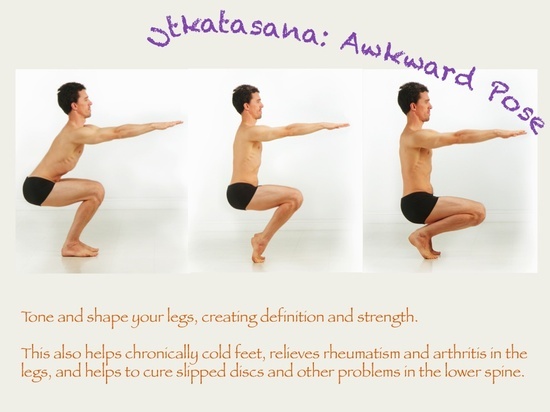
Come up as high as possible onto your toes. Watch the alignment of your ankles, they should be straight and not shooting out or in from the alignment of your legs. Concentrate mostly on the first and second toes of each foot pressing into the floor. Below is a photo of Bikram Choudhury in the second part of Awkward Pose. Look how high he comes up on his toes!


Sit your hips all the way into the chair, but don't go below the chair. Rotate your pelvis under you to get rid of the "duck butt" and to keep your back perfectly straight.

Shaking, burning and discomfort is a good thing. It means you are burning calories and building muscles. From famous Bikram yogi Emmy Cleaves: “Whenever there is shaking, there is always a threatened nerve. It’s NEVER an impulse saying, “If you keep going there could be trouble.” Shaking is not bad, it is your body creating new neural passageways and learning to strengthen and hold.” 

If your upper body is leaning forward, this means you must come up higher on the toes. Don’t be scared to come as high as possible on the toes. Remember that Bikram often says this posture should one day be done just on the big toe.

Come up from the second part slowly to build more strength in the legs. Before you know it, your legs will be toned and shaped like nobody's business!

*Check back next week for the third part of Awkward Pose.

Wednesday, April 24, 2013

Tip of the Week: First Part of Awkward Pose

There are so many great benefits to Awkward Pose. Toned and shapely legs, relief from rheumatism and arthritis in the legs, aligned skeletal system, sciatica relief, flexibility in the toes and ankles, and relief from menstrual cramping!


There are three parts to Utkatasana, or Awkard Pose. Today we'll be exploring the first part.

Separate your feet so they are shoulder-width apart or about 6 inches between them. (The best way to measure this is to bend down with both fists side-by-side between your feet.)

Throughout the posture, your heels stay behind the toes invisible in the front mirror. Heels do not turn in or out but remain in perfect alignment, so they make a perfect "number 11". 

Extend your arms out and hold them up shoulder height for the duration of the pose, never dropping them. Engage your triceps as hard as you can as you straighten your arms out in front of you, extending from your shoulders to the tips of your fingers.

Breathe out on the way down and in on the way up. 

Exhale and lower your hips, bending the knees forward, until your thighs are just up from parallel. Your pelvis should be positioned in line with your heels and about 2 inches higher than your knees.

Maintaining a straight back and keeping the abdominals tight, begin to sit deep, bending the knees as if you're going to sit in a chair directly behind you. Push your booty back, waaaay back. Imagine you're going to fall backwards. Push your heels into the ground while keeping your toes on the ground.
Roll your shoulders back and lift your ribcage, keeping your sternum straight and perpendicular to the floor until your chest is open. Make sure that when you lift your ribcage that it is just a lift, not a push forward with a lift.

Straighten your neck, balancing your head evenly between your shoulders, until your chin is parallel with the floor. Throughout the entire posture, keep your eyes fixed in the mirror. Don't even blink your eyes or you may lose your balance.

*Check back next week for the 2nd part of Awkward pose!


Wednesday, April 17, 2013

Tip of the Week: Practicing With Knee Problems

We've heard many people ask, "Is it safe to do yoga with my knee problems?"

 
Whether the knees are arthritic or injured, Bikram yoga will definitely help. Bikram Choudhury actually healed his knee, which was crushed by a 300 pound weight, with his guru's help doing yoga. You must move the knees to get circulation to them, and Bikram's yoga helps you do both.

Make sure to listen carefully to the alignment instructions in each posture. When you are told to keep your feet parallel in standing postures, please do so. A half inch in either direction away from parallel has its effects all the way up the knees and into the hips.

In standing balancing postures, it is also important to keep the standing foot straight and the standing knee pointing straight ahead. If your knee bows back (hyperextension) you should bring the weight forwards towards the toes so as to engage the quadriceps muscle ("lock the knee") and lift the kneecap upwards. This action brings the leg into one line and brings true strength to the knees.

When you are bending your knees in any of the standing postures, keep the knees pointed over the toes. This will ensure that the knees and hips are strengthened evenly inside and out.

In triangle, when you are told to push your hips forward as you bend your front knee, this will keep your hip in line with your knee in line with your foot. This is also good for even strengthening of hip and knee joints.

In some of the standing postures, it might be very difficult to bend your knee to a 90 degree angle. So do the best you can without creating pain. Better to keep proper alignment bending 1% than to go 100% in poor alignment.

In the floor poses (fixed firm, half tortoise and rabbit), it might be difficult for you to bend your knees enough that the hips sit on the heels. To test your knee flexibility, keep lots of weight in your hands and bend the knees gradually to the point (but not past) of pain. You must be able to relax and breathe in the posture, holding it steady, for anything to happen. As the pain decreases and you start feeling more comfortable, you can gradually take the weight out of your hands and allow more pressure on the knees. Eventually you'll be able to go all the way into the posture, and you won't even remember the time when you couldn't even sit down!  

Wednesday, April 3, 2013

Tip of the Week: Wind Removing Pose


Benefits :
  • Wind-Removing Pose compresses and massages the ascending colon and descending colon.
  • It also messages the transverse colon and compresses the entire digestive system.
  • It strengthens the arms, prevents flatulence, improves hip flexibility, and firms the abdomen and thighs.
Tips:
  • Keep your elbows close to the body.
  • Fully interlace the fingers all the way to the webbing and take hold of the raised leg two inches below the knee.
  • Keep pulling to your same shoulder until you feel a pinch in your hip joint.
  • Keep both of your shoulders all the way on the floor.
  • When you are pulling in both of your knees look down through the diamond that is created between your arms and legs.
  • If you can't reach both of your elbows when pulling on both of your knees, keep trying! One day you will be able to grab both elbows.
  • If your arms keep slipping when grabbing both elbows, imagine that you are trying to push your knees down towards your buttocks. If you are trying to pull your knees up towards your face, your arms are likely to slip.
  •  Try not to wear body lotion before class. It can really make postures more difficult by causing your grip to be slippery.

Wednesday, March 27, 2013

Happiness is a Choice

This week's tip is simple. Realize that happiness is a choice. YOU are the one who determines your emotional state. These great tips below from Life'd and a healthy Bikram practice will help you to become a happier person!


Happiness is not something ready made. It comes from your own actions. – Dalai Lama

There are two types of people in the world: those who choose to be happy, and those who choose to be unhappy. Contrary to popular belief, happiness doesn’t come from fame, fortune, other people, or material possessions. Rather, it comes from within. The richest person in the world could be miserable while a homeless person could be right outside, walking around with a spring in every step. Happy people are happy because they make themselves happy. They maintain a positive outlook on life and remain at peace with themselves.
The question is: how do they do that?
It’s quite simple. Happy people have good habits that enhance their lives. They do things differently. Ask any happy person, and they will tell you that they …

1. Don’t hold grudges.

Happy people understand that it’s better to forgive and forget than to let their negative feelings crowd out their positive feelings. Holding a grudge has a lot of detrimental effects on your wellbeing, including increased depression, anxiety, and stress. Why let anyone who has wronged you have power over you? If you let go of all your grudges, you’ll gain a clear conscience and enough energy to enjoy the good things in life.

2. Treat everyone with kindness.

Did you know that it has been scientifically proven that being kind makes you happier? Every time you perform a selfless act, your brain produces serotonin, a hormone that eases tension and lifts your spirits. Not only that, but treating people with love, dignity, and respect also allows you to build stronger relationships.

3. See problems as challenges.

The word “problem” is never part of a happy person’s vocabulary. A problem is viewed as a drawback, a struggle, or an unstable situation while a challenge is viewed as something positive like an opportunity, a task, or a dare. Whenever you face an obstacle, try looking at it as a challenge.

4. Express gratitude for what they already have.

There’s a popular saying that goes something like this: “The happiest people don’t have the best of everything; they just make the best of everything they have.” You will have a deeper sense of contentment if you count your blessings instead of yearning for what you don’t have.

5. Dream big.

People who get into the habit of dreaming big are more likely to accomplish their goals than those who don’t. If you dare to dream big, your mind will put itself in a focused and positive state.

6. Don’t sweat the small stuff.

Happy people ask themselves, “Will this problem matter a year from now?” They understand that life’s too short to get worked up over trivial situations. Letting things roll off your back will definitely put you at ease to enjoy the more important things in life.

7. Speak well of others.

Being nice feels better than being mean. As fun as gossiping is, it usually leaves you feeling guilty and resentful. Saying nice things about other people encourages you to think positive, non-judgmental thoughts.

8. Never make excuses.

Benjamin Franklin once said, “He that is good for making excuses is seldom good for anything else.” Happy people don’t make excuses or blame others for their own failures in life. Instead, they own up to their mistakes and, by doing so, they proactively try to change for the better.

9. Get absorbed into the present.

Happy people don’t dwell on the past or worry about the future. They savor the present. They let themselves get immersed in whatever they’re doing at the moment. Stop and smell the roses.

10. Wake up at the same time every morning.

Have you noticed that a lot of successful people tend to be early risers? Waking up at the same time every morning stabilizes your circadian rhythm, increases productivity, and puts you in a calm and centered state.

11. Avoid social comparison.

Everyone works at his own pace, so why compare yourself to others? If you think you’re better than someone else, you gain an unhealthy sense of superiority. If you think someone else is better than you, you end up feeling bad about yourself. You’ll be happier if you focus on your own progress and praise others on theirs.

12. Choose friends wisely.

Misery loves company. That’s why it’s important to surround yourself with optimistic people who will encourage you to achieve your goals. The more positive energy you have around you, the better you will feel about yourself.

13. Never seek approval from others.

Happy people don’t care what others think of them. They follow their own hearts without letting naysayers discourage them. They understand that it’s impossible to please everyone. Listen to what people have to say, but never seek anyone’s approval but your own.

14. Take the time to listen.

Talk less; listen more. Listening keeps your mind open to others’ wisdoms and outlooks on the world. The more intensely you listen, the quieter your mind gets, and the more content you feel.

15. Nurture social relationships.

A lonely person is a miserable person. Happy people understand how important it is to have strong, healthy relationships. Always take the time to see and talk to your family, friends, or significant other.

16. Meditate.

Meditating silences your mind and helps you find inner peace. You don’t have to be a zen master to pull it off. Happy people know how to silence their minds anywhere and anytime they need to calm their nerves.

17. Eat well.

Junk food makes you sluggish, and it’s difficult to be happy when you’re in that kind of state. Everything you eat directly affects your body’s ability to produce hormones, which will dictate your moods, energy, and mental focus. Be sure to eat foods that will keep your mind and body in good shape.

18. Exercise.

Studies have shown that exercise raises happiness levels just as much as Zoloft does. Exercising also boosts your self-esteem and gives you a higher sense of self-accomplishment.

19. Live minimally.

Happy people rarely keep clutter around the house because they know that extra belongings weigh them down and make them feel overwhelmed and stressed out. Some studies have concluded that Europeans are a lot happier than Americans are, which is interesting because they live in smaller homes, drive simpler cars, and own fewer items.

20. Tell the truth.

Lying stresses you out, corrodes your self-esteem, and makes you unlikeable. The truth will set you free. Being honest improves your mental health and builds others’ trust in you. Always be truthful, and never apologize for it.

21. Establish personal control.

Happy people have the ability to choose their own destinies. They don’t let others tell them how they should live their lives. Being in complete control of one’s own life brings positive feelings and a great sense of self-worth.

22. Accept what cannot be changed.

Once you accept the fact that life is not fair, you’ll be more at peace with yourself. Instead of obsessing over how unfair life is, just focus on what you can control and change it for the better.

Tuesday, February 19, 2013

Yoga Hygiene: A Response

Thank you to student Sheri Rysdam for this reponse to a previous post on how to be less stinky in class:
 
Today my studio published a guest post from Yoga Peach on how to maintain good hygiene when practicing hot yoga. When you are practicing hot yoga on a regular basis, having a good hygiene routine is a must. Having a daily practice can easily result in the accumulation of heaps of sweat-soaked yoga clothes, towels, and mats. When left wadded up in a car or in the bottom of a laundry basket, a real bacteria and odor problem can result. 

I’d like to add a few points to the topic, and maybe even contest a few points made in Yoga Peach’s post.  

1. You’ve Got Some Time
First, bad body odor is a result of bacteria growth. That means if you are clean and if your clothes are clean, you will not develop a bad odor during class, or in the hour or so after class. That means you *can* stop by the store for a quick coconut water purchase because, if you were clean to begin with, you probably won’t start to develop an odor until you’ve “sat in it for awhile,” which is not something I advocate…especially if you want to maintain a long-term yoga practice, friends, and loved ones.


2. Women Can Be More Sensitive to Odor
It seems that men tend to be less sensitive to odor than women. While I’m sure that I could link to quick research that supports my claim, I’ll just use this anecdote: my appliance repair guy recently told me that women are far more likely than men are to smell a gas leak in the house or an extinguished pilot light. The take away is that men who practice hot yoga need to be that much more diligent about cleanliness because what goes unnoticed by the man might be distractingly strong to the woman practicing next to him.


3. Launder Your Mat
Cleaning the mat is a must. In addition to wiping down the mat with your studio’s cleaning solutions, vinegar water, and/or other natural cleansers, did you know that most yoga mats can also be laundered in the washing machine? It’s true! Using a washing machine can be a great way to more thoroughly clean your yoga mat. (Disclaimer: You’ll want to double check the specs of your mat and your washing machine before proceeding.) This practice can reduce the overall lifespan of a mat, so it’s not a good option for daily cleaning. It’s more of a “once in a while” type of thing. I learned this “washing machine” tip from a fellow yogi who also laundered new mats to get rid of the slick, plastic film that some “sticky” mats have when they are brand new. If you use the washing machine, remember that you should let your mat dry completely before using it again. Because mats are made of varying degrees of thickness and materials, they usually take much longer to dry than lightweight towels. Plan accordingly.


4. Follow a Routine
I’m doing a 30-day Bikram challenge right now, so keeping up with hygiene is an essential daily practice. When I leave yoga, I follow a strict routine. I live very close to my studio, so I usually drive home and shower there. I immediately launder my towel and clothes and hang my mat to dry. If I cannot launder the clothes immediately, I hang them to dry. This is a daily (and somewhat time consuming) practice. However, if I do not practice this ritual, the various fabrics will develop an odor. It’s gross, I know, but it’s the reality of hot yoga.