Visit our website!

Tuesday, March 29, 2016

Tip of the Week: Bikram for Balancing Emotions


Yoga has the power to unlock, heal and balance your emotions. For those of you who have a regular practice, you can probably attest to lying down in Savasana at one point with tears streaming down your face or smiling so hard your face hurts. 

Though a sudden onset of emotions during a routine yoga session takes many practitioners by surprise, it’s really an important part of the discipline. That’s because there’s no differentiation between the mind, the body, and human emotions within yoga. They’re all connected, and, as such, they all affect each other. Yogis will tell you that when something weighs you down mentally, it'll likely weigh you down phyically, too. And that remains true whether you follow yoga’s tenets or not. For example, severe stress has a demonstrated effect on heart health, but within yoga specifically, certain body parts are believed to carry different types of emotions. As Sarah Powers wrote in the book Insight Yoga, “We may experience disappointment in a tight hip or fear as we settle into a long-held backbend. The longer we practice, the more we notice how varied our feelings are, how we can feel agitation one minute and elation the next, exuberance followed by despair.”

Poses that tap into tension in the hips, chest, and back seem to prompt emotional releases most often during yoga sessions. Frustration and anger could manifest in spinal tension, heartbreak and depression could linger in the chest, and emotional pain from the past could lie dormant in the hip flexors. These moves can help you confront such unresolved issues.

Bikram Yoga helps balance the emotions in several ways. Physiologically, regular practice harmonizes the nervous and endocrine systems, two systems which figure heavily in emotional well-being. In addition, practicing Bikram Yoga cultivates the mental faculties of faith, self-control, concentration, determination, and patience. As we become more aware of our inner life, we notice how events, interactions, and even the atmospheric pressure effect us. When we are aware, we can exercise choice in our response. This helps us balance our emotional life. 

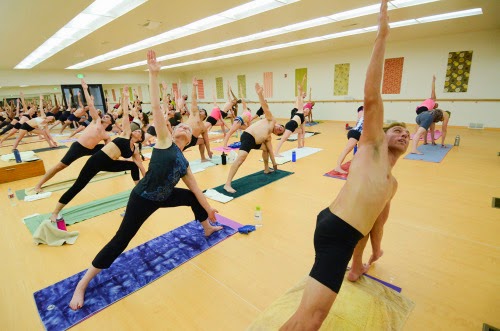
Triangle Pose: The farther you extend your torso to the right and stretch your arms, the more you challenge your hips to let go of tension.

Camel Pose: Because you make your heart so open (and vulnerable) in this pose, it often leads to dramatic emotional displays, from giggling to sobbing.

Bridge Pose: This pose is a gentler way to release emotions, because you slowly ease your body into it. The chest opening isn’t quite as stark, but it still makes a difference.

Spine Twist: Twisting the spine in either direction awakens your organs and abdominal muscles as well.

Savasana: This is a completely neutral pose that allows for total relaxation of the mind and body. Resting poses don’t tax the body, but they do cause you to center your thoughts, which can be very emotionally taxing for some people.

Using poses like these to move past mental and emotional blocks is part of moving forward in your yoga practice. Breathing deeply and staying centered in the pose are a healthy way to release such tensions. But if it gets to be too much, you should come out of the pose and allow yourself to experience the emotions fully—otherwise, it’s simply another means of suppression. Be sure to talk to your studio instructor for more insight into the phenomenon. After all, exploring and finding the balance between mind, body, and emotion is likely why you came to yoga in the first place.

Tuesday, March 22, 2016

Tip of the Week: Yoga is Perfect for Weight Loss


For many of us, the first step on the journey to weight loss is through the gym doors. The glistening and toned physiques at the weight rack, on the treadmills, and in spin class briefly inspire us that the best way to shed those stubborn pounds is to lift heavier, run faster, and push harder. But, if this is really the key to permanent weight loss, then why do so many walk away from the gym exhausted, frustrated, and defeated in their efforts?

The Yoga Difference: Mental Health Meets Physical Health

We often overlook that weight loss is just as much a mental and soulful experience as it is physical. Aligning your mind, body, and soul is the key to sustainable health, and it can often be found among the serene music and warming breaths of a yoga class. Yoga, unlike other exercises, gives you something uniquely special because helps heal your mind, body and soul. Yoga will support your weight loss transformation as you identify with what will ultimately bring you joy and happiness, and it will inspire you to "live with purpose", which will support your decisions to become as happy and healthy as possible.

In that spirit, and in the spirit of the new year, here are 9 ways yoga will support a new relationship with your body and help you lose weight.

1. Disconnect From Technology

 Instead of looking at other people and what they're doing to lose weight, yoga supports a quiet state of mind, so you can make decisions that are best for your body. You will be inspired, your energy and vibration will shift, and you will begin to feel gratitude for the smallest things without needing to compare yourself to others.

2. Work With Wonderful, Experienced Teachers 

Your friends and family can be great role models, but to transcend your circumstances, you often have to remove yourself from your current space of understanding. Being around inspirational teachers helps you build your own thoughts and beliefs inspired by their teachings. They will often become a mirror of your own weaknesses and insecurities and help you find a way past them. These teachers who have blazed the trail before you (many of whom have had their own weight loss journey) provide a powerful road map for your own growth.

3. Spend Time With An Incredible Community

 Having the ability to become part of an incredible community—people who are working towards similar goals right along with you—is incredibly powerful. Your fellow yogis will praise you when you do well, encourage you when you feel hopeless, and help point you in the right direction when you get off track. The power within you is always guiding you; sometimes you just need a bit of help (and positive friends) to harness it.

4. A Guaranteed Break 

Spend time meditating and allow yourself to stop over-thinking. In a world of constant information (especially about diets), this is often one of the most difficult things to do, yet it is one of the most important things to learn for your well-being. Turning off all the noise, including your own voice, judgments and outside perceptions, for just 45 minutes truly frees you. It allows you to open up to a sacred space of healing which welcomes happiness and empowers you to make improved decisions when it comes to your food and exercise.

5. Heal The Past

 Individuals often experience profound healing and new states of awareness during yoga. Being in an environment where you are not distracted by other things allows you to move closer to forgiveness—one of the most important components of permanent weight loss. We often hold weight because of guilt that we carry inside ourselves. Yoga offers a space of compassion and love that can help propel you forward.

6. Experience A Space Beyond Your Current Circumstance 

Money, time, work, and toxic relationships can drag you down and make you feel trapped in your current reality, causing binging and unhealthy eating behaviors. You have to live beyond what you have now and believe in what you can become. Yoga allows you to experience this unique space. As the Law of Attraction states, living within the mindset of the future version of you helps it actually come to you!

7. Embrace Fear 

Yoga is a safe space to embrace your fear, harness the energy behind that fear, and remove it from your life. We're often fearful of things we truly desire, so there is fear around losing weight. Who will we be when we don't have the weight as a protection against the world? Who will we be when we are healthy and filled with energy? Quieting the mind helps us to understand where the fear of losing weight comes from and offers the ability to move through it to create dramatic shifts in your life.

8. Bust Through Blockages 

Yoga testimonials often state that individuals were able to break through blockages and limiting beliefs. Most of us carry around childhood memories, past traumas, and pain, causing severe stress in our subconscious that manifests in negativity and fear. Yoga helps create a space where our conscious and subconscious thought patterns can unite to break through these feelings, shedding mental (and physical) weight.

9. Finally Make a Commitment To A Healthier Life 

After several yoga classes, your body will begin to cleanse, detoxify, and heal. As your body cleanses and detoxes, you actually retrain your brain from craving junk food to desiring more real, healthy food. Being in an environment that supports that energetic shift in your body will help you stay on track no matter where in the world you may be.

Without a doubt, yoga is one of the best things you can do to create dramatic shifts not only in your mind, but also in your body. Being in an environment where you can focus and make a commitment to your well-being alters your life forever. As you spend several days moving closer to a "new" way of being, you are actually announcing to the Universe that you are ready to permanently live this way.

By Sarah Anne Stewart, Health Coach charlottesbook.com

Tuesday, March 15, 2016

Tip of the Week: Take the Balance Test!


  • It benefits your neuromuscular coordination – basically it helps improve the communication between your brain and muscles.
  • It helps with muscle isolation – during balance training you have to maintain stabilization and you are forced to engage an individual muscle predominantly so that you are not using other muscles to help you “cheat.”
  • During balance training your body has to work that much harder to stabilize – in turn this helps you to burn more calories.
  • It helps w hip stabilization – with single leg type balance exercises your glute medius is engaged and worked.  Therefore, this helps with hip stabilization. 
  • It helps with core stabilization – this in turn helps to improve your coordination, athletic skill, and posture.
  • - See more at: http://www.activecenterforhealthandwellness.com/blog/active-news/the-5-major-benefits-of-balance-training-do-not-neglect-it#sthash.YuKXXCWq.dpuf
    Why are the balancing postures like Eagle Pose, Standing Head to Knee, Standing Bow Pulling, Tree Pose, and Balancing Stick so important in our practice? Working on your balance has many benefits!

    1. It benefits your neuromuscular coordination - basically it helps improve the communication between your brain and muscles.

    2. It helps with muscle isolation - during balance training you have to maintain stabilization and you are forced to engage an individual muscle predominantly so that you are not using other muscles to help you "cheat". 

    3. During balance training your body has to work that much harder to stabilize - in turn this helps you to burn more calories.

    4. It helps with hip stablization - with single leg type balance exercises your glute medius is engaged and worked. Therefore, this helps with hip stabilization.

    5. It helps with core stabilization - this in turn helps to improve your coordination, athletic skill, and posture.   


  • It benefits your neuromuscular coordination – basically it helps improve the communication between your brain and muscles.
  • It helps with muscle isolation – during balance training you have to maintain stabilization and you are forced to engage an individual muscle predominantly so that you are not using other muscles to help you “cheat.”
  • During balance training your body has to work that much harder to stabilize – in turn this helps you to burn more calories.
  • It helps w hip stabilization – with single leg type balance exercises your glute medius is engaged and worked.  Therefore, this helps with hip stabilization. 
  • It helps with core stabilization – this in turn helps to improve your coordination, athletic skill, and posture.
  • - See more at: http://www.activecenterforhealthandwellness.com/blog/active-news/the-5-major-benefits-of-balance-training-do-not-neglect-it#sthash.YuKXXCWq.dpuf

    Is your balance up to par?


    Take the 30-Second Balance Test (from saveourbones.com)

    First, you’ll need to find a partner to time you, because your eyes will be closed. It’s also important to have someone close by in case you fall. 
    1. Stand barefoot on a hard floor. Now close your eyes.
    2. Bend one knee and lift the foot – if you’re left-handed, stand on your left leg and lift the right foot; do the opposite if you’re right-handed. You don’t need to lift it high; even though your eyes are closed, you can probably estimate about 6 inches off the floor.
    3. Ask the person with you to check his or her watch, and time how long you can hold that position without wobbling or opening your eyes.
    4. Repeat the test 3 times, and then add up your total time and divide it by 3 to find your average balance base. (For example, if test 1 was 4 seconds, test 2 was 8 seconds, and test 3 was 6 seconds, you’d add up 4, 8, and 6 to get 18. Divide by 3, and your average balance time is 6 seconds.)


      Not surprisingly, the chart shows that the number of seconds decreases with age. In the 25-30 year group, for example, the average eyes-closed balance time is 28 seconds. For 50-year-olds, it’s 9 seconds; 65-year-olds average 5 seconds, and 70-year-olds 4 seconds. That’s because…

      Balance Tends To Decrease With Age

      As we get older, our eyesight tends to diminish, throwing a wrench in the first step in good balance (vision). Muscles tend to shrink and your reaction time may be a bit slower. But there’s good news, because…

      You Can Improve Your Balance Regardless Of Age

      You don’t have to be resigned to poorer balance as you age. You can take action to improve and maintain it. 

      A study published last year shows that there’s scientific validity to the "Flamingo trick" which involves standing on one leg while doing an every day chore.

      Researchers conducted a trial to study the effectiveness of the “dynamic flamingo exercise” in preventing falls. They found that periodically standing on one leg does in fact improve balance, prevent falls, and even improve independent living.
       
      In a meta-analysis review of 17 trials involving a total of 4305 participants aged 60 and older, researchers concluded that regularly engaging in balance exercises not only prevented falls, but actually prevented injury (including fractures) when falls did occur. Even in the case of severe falls, injuries were less common among those who exercised regularly.


      We suggest you practice balancing Bikram postures for a few weeks, and then repeat the balance test!

      Monday, March 7, 2016

      Tip of the Week: 4 Yoga Poses for Digestion

      Doing these four simple yoga poses as suggested by yogawithpaul will soothe your system, boost digestive function, and help you feel more like yourself.


      Wind-removing pose: Do this any time to gently stimulate your digestion and encourage elimination. If you’re doing it at home, hold it for longer than you would in class, breathing mindfully and deeply to get the best massage for your colon.

      Hands to feet pulling pose: This is another wonderful massage for your internal organs. Pulling your body tight against your thighs means no room for light or air anywhere on the outside, and no room for excess on the inside either! Bend your knees as much as you need to to keep a good compression between your abdomen and thighs.

      Cobra pose: Lying on your belly puts gentle pressure on your stomach and digestive system, encouraging the movement of any trapped wind. As you rise, really contract your back and leg muscles to strengthen this massage.

      Savasana: Embrace the benefits of stillness. Whether you’ve over-eaten, drunk too much, or simply gotten stressed out by everything, taking a few minutes to relax in corpse pose, breathing evenly in and out through your nose, is a great way to calm the body and bring it back into balance.

      Tuesday, March 1, 2016

      Tip of the Week: Deepen Your Practice With a Mindful Embrace

      Loving this article by Marianne Hayes for Yoga Journal.


      Looking to deepen your meditation practice? It turns out that embracing someone in a mindful hug might help you do just that. Hugging meditation, made famous by Zen Master Thich Nhat Hanh, is rooted in the belief that a good hug can have transformative effects.

      “When we hug, our hearts connect and we know that we are not separate beings,” Hanh writes. “Hugging with mindfulness and concentration can bring reconciliation, healing, understanding, and much happiness.”
      Hugging is good for more than just our relationships. In fact, the scientific community has long touted its many health benefits. For one, experts say interpersonal touching decreases stress levels by slowing down our heart rate and production of the stress hormone cortisol. During cold and flu season, making time for regular hugs may keep you healthy, as they appear to boost immune function and protect against the common cold. Hugging is also thought to simultaneously calm our fears and alleviate feelings of loneliness. Remember that next time you’re feeling blue.

      The best part is that our everyday interactions can double as opportunities to easily reap these benefits. Mindfulness expert Susan Piver, author of Start Here Now, says that scheduling formal hugging meditation sessions probably isn’t necessary.
      “Instead, when you’re hugging someone in your everyday life, make it a meditation,” she says. “Really pay attention because it’s so warm and physical and intimate. When I hug someone, I notice that I find it enjoyable to change my focus back and forth between what it feels like to hug and what it feels like to be hugged.”

      Ready to Give Hugging Meditation a Try?


      To get the most out of the experience, Zen Master Thich Nhat Hanh advises doing the following:


      1. Begin by recognizing the other person.

      Start by bowing toward the other person as a way of acknowledging their presence. Then bring yourself fully into the moment by taking three conscious breaths.


      2. Go in for the hug (and keep your breathing in mind).

      A quick pat on the back won’t really do the trick here. Instead, hold the other person in your arms for three deep breaths. Hanh writes that the first breath should be devoted to you honoring your presence in the moment. The second should honor the other person, while the final breath should be focused on feeling happy and grateful for your togetherness.


      3. End with gratitude.

      After you release each other, finish the experience by bowing again to express thankfulness for the other person.

      Monday, February 22, 2016

      Tip of the Week: 10 Things a Yoga Teacher Learns About You in the First 5 Minutes

      on rodalesorganiclife November 19, 2015

       
                                     PHOTOGRAPH BY JACK RADCLIFFE/GETTY

      Have you ever wondered what is running through your yoga teacher’s mind during class? Is she eyeing you up and down, calling out in her head everything that’s wrong with your health? What exactly does she know just by looking at you and your practice?
      And what other intel are instructors privy to? We tapped some of our yoga teacher friends to find out just what they can say about you and your health based on your practice.

      1. What Other Sports You Play


      PHOTOGRAPH BY JUSTIN STEELE


      For example, runners often have tight ankles and struggle with postures that involve sitting on their knees, such as Bikram’s Fixed Firm and Child’s Pose.

      2. If You've Had Knee Injuries


      PHOTOGRAPH BY MARGARET SKROVANEK

      The signs? You’re hesitant to put all your weight on one leg, you struggle with balancing postures, and you’re reluctant to straighten your knees.

      3. You Might Have A Weak Lower Back


      If you go off into a corner to start Savasana early while everyone else is doing backbends, you probably consider the area above your sacrum a trouble spot.
      Pro tip: Teachers say that more back injuries actually occur from forward bends. 


      4. You're Type A


      PHOTOGRAPH BY MITCH MANDEL

      Being overly ambitious and pushing through poses beyond your current ability—a telltale sign that you’re a Type A personality—will likely end up hurting more than helping. But remember: Some of the most beneficial poses aren’t necessarily the acrobatic ones. In some traditions, Savasana offers the most benefits to body and mind. 


      5. You've Had Too Much Caffeine


      PHOTOGRAPH BY RODALE IMAGES


      If you’re fidgety, falling out of balancing poses, and constantly looking around you, too many cups of morning coffee might be the culprit of your lack of focus.


      6. You Are Hungover


      PHOTOGRAPH BY LIVESTOCK IMAGES/GETTY


      If you’re extra slow to get into postures, can’t keep up with the flow, and are taking frequent breaks, you’re likely suffering from a late night out. (The other telltale sign is the smell of booze that oozes from your skin.) 


      7. You're Having a Bad Day


      PHOTOGRAPH BY 123DUCU/GETTY

      Teachers say that not looking in the studio mirror at all throughout class is a sign that you might be feeling a little down in the dumps.


      8. You Need to Poop


      PHOTOGRAPH BY ALEX BRAMWELL/GETTY

      Wind-removing poses (lying on your back, hugging knees to chest) and inversions (Shoulderstand and Plow) are the most likely triggers for passing gas in class. 


      9. How Often You Practice


      PHOTOGRAPH BY JONATHAN FIFE/GETTY
      Are you eager to hit the mat when you get to the studio? Do you move through postures with ease? Do you geek out about yoga in the lobby after class instead of planning post-yoga drinks? If you answered yes, then you’re likely a frequent yogi.

      10. You’ve Got A Big Head


       PHOTOGRAPH BY ALEX GRABCHILEV/EVGENIYA BAKANOVA/GETTY

      If you move too quickly through poses, constantly look in the mirror, and appear to be in competition with the people around you, you might be guilty of being egotistical.


      on rodalesorganiclife November 19, 2015

      Monday, February 15, 2016

      Tip of the Week: Breathe Clean Air!

      We were graced with a storm this last weekend which helped to clean out some of the pollution in our air, but our air quality in Utah is still far from great. Practicing Bikram yoga in our state-of-the-art fresh air system is much safer for your respiratory system than any outdoor exercise.

      There was a Salt Lake Tribune article from Jan 4, 2016 titled "Running a risk: Is it safe to exercise during a Utah inversion?" It states that according to Robert Paine, a pulmonary physician at University of Utah Hospital, when people exercise, they breathe faster to bring more air into their bodies. Anything in the air small enough to bypass the respiratory system's natural defenses also comes in with each breath, so those who exercise outdoors when the air quality is poor get a much bigger dose of pollutants — making 3 miles feel like 6, lengthening recovery time and increasing one's risk of having a heart attack that day. And exercising repeatedly in bad air could possibly lead an athlete to develop asthma.


      Below is a previous post of ours titled "Tip of the Week: Breathe Fresh Air" to remind you why it's a good idea to come and let your lungs breathe fresh clean air for 90 minutes in our studio. Ahhh...


      With the air quality in our city being so poor lately, have you wondered why you actually find it easier to breathe in the studio? This is because our studio at Bikram Yoga SLC has a specialized fresh air and heating system that is the perfect marriage between fresh air, heat, and humidity. We have developed a state-of-the-art fresh air system that pumps fresh air along with consistent heat and humidity. We have made every effort to care for the health of our yogis by ensuring that the air quality in the studio is well oxygenated, properly humidified and disinfected from harmful germs.

      At Bikram Yoga SLC the room is always being pumped with fresh oxygenated air! We knew there had to be a better system than simply closing the doors and turning up the heat. We've gone through great lengths to maintain the air quality in our studio within a healthy range.  Our fresh air system pulls air from the outside, and goes through a large complex filtration system, eliminating all airborne bacteria. This fresh air is pumped through the system along with consistent heat and humidity. The result is fresh air that doesn’t smell and is not full of harmful bacteria. 

      Ever wonder why Bikram Yoga SLC does not smell badly?  We have spent the time, energy and expense to make sure that our classes never smell and that you are breathing the freshest cleanest air possible. Our clean air system will greatly reduce CO2 levels and eliminate and destroy: bacteria, odor, mold & mildew, viruses, V.O.C.’s, cleaning chemicals, smog and other airborne pollution. 

      The benefits of a clean air environment are enormous. Clean air will help prevent colds and influenza, prevent headaches after class, provide relief from asthma, hay fever and sinus problems, reduce fatigue, and breathing problems, and relieve sore throats, runny noses, wheezing and sneezing. Practicing yoga at Bikram Yoga SLC will  have a dramatic effect upon your physical and mental well being.

      Where is the coolest spot in the room? Unlike other studios that are thermostat controlled where there are hotter and cooler spots, our studio does not have this problem. Due to our system, there is a consistent temperature of 105 degrees and 40% humidity every minute of class, regardless of the number of people in the room or how hard they are working. Instead of a thermostat that just switches on or off, we use sensors in the room that can sense accurately the temperature and humidity in the room, and give instant results. Everything works on a bell curve, to instantly increase or decrease fresh air flow, heat and humidity depending on class size. The speed of the motors is always changing during class.

      All is computer controlled with accuracy down to the hundredths. All of the variables are computerized with a software program written specially for us so we can monitor our system and see that the temperature, humidity, and fresh air is always consistent. We can see that as the students are emitting more heat and breathing harder in the cardiovascular series, such as Standing Head to Knee Pose, the motors of the system begin to speed up to pump in more fresh air and remove the bad air. At the same time, the heat in the room is being decreased. The system knows what's happening in your body before your body can even sense it. The CO2 levels are kept to a minimum, and you are able to breathe easily.

      So the next time you're in class and you hear the teacher say, "inhale"...you can really "INHALE"! You will be oxygenating and energizing the cells in your body with very fresh, healthy air.

      Monday, February 8, 2016

      Tip of the Week: Adapt to Your Challenges

      Whatever your views are on yoga competitions, the feeling of inspiration will be undeniable after reading about a couple of these determined yogis. Both were awarded first place in the women's division for their state in the USA Yoga Mountain States Asana Championship. 

      Kira Brazinski, who has a prosthetic leg, hopes to motivate someone who may have lost a limb or who has a disability to try yoga. "For me, really for everyone, yoga is about modifying and adapting to your body's strengths and challenges."

      Our very own teacher Charese Peterson, from Utah, in the past had struggled with addiction to painkillers and had insomnia and anxiety prior to practicing yoga. "It's not a competition to prove you're better than someone. It's more to spread awareness for yoga, and you never know who you may be saving."

      The full article from Jackson Hole News & Guide is below:

      A contest with a greater purpose

      Posted: Wednesday, February 3, 2016 4:30 am
      Gasps of astonishment echoed from the walls of the Pink Garter Theatre on Saturday when Kira Brazinski lifted her prosthetic leg toward the ceiling to complete adho mukha vrksasana, the Sanskrit name for a yoga handstand pose. In fact, the final posture the Jackson resident assumed during the USA Yoga Mountain States Regional Asana Championship earned her a standing ovation and first place in the women’s division for Wyoming.
      One person who rose from his seat was judge Abhinav Sagar, who said Brazinski’s strength and determination defines yoga.
      “It was beyond imagination,” Sagar said. “It really touched me. I had never seen something like that before.”
      Sagar believes that yoga competitions are about connecting the mind, body and spirit in order to inspire. He surely felt inspired by Brazinski.

      The champion, however, had a different opinion about yoga competitions when she first heard one was going to be hosted in Jackson.
      “It seemed like it was defeating the purpose to make yoga, which is something focused around acceptance and nonjudgment, competitive,” she said.
      Once she got on stage to execute six asana postures in three minutes, Brazinski had a change of heart.
      She realized it wasn’t about proving she had more talent than the other competitors. It was about encouraging audience members to hit the mat to try their hand at the discipline.

      Brazinski, who was born with one leg shorter than the other, hopes that her demonstration Saturday will motivate someone who may have lost a limb or who has a disability to try yoga, which she says is a practice anyone is capable of doing.
      “For me, and really for everyone, yoga is about modifying and adapting to your body’s strengths and challenges,” the competitor said.

      Brazinski, who teaches at Inversion Yoga, wasn’t the only one who participated Saturday with hopes of motivating people to try yoga. Charese Peterson, a competitor from Ogden, Utah, who finished her three-minute routine in a deep backward bend known as full camel pose, wanted people to witness how yoga had helped her.
      “I was struggling with years of addiction to painkillers,” Peterson said, “and I had anxiety and insomnia.”

      After the winner of the Utah Division started practicing yoga on a regular basis she no longer felt she needed to take painkillers or antidepressants.
      Like Branzinski, Peterson feels that yoga competitions have a larger purpose.
      “It’s not a competition to prove you’re better than someone,” Peterson said. “It’s more to spread awareness for yoga, and you never know who you may be saving.”

      Dien Huynh, Colorado’s first place winner, said he participated in the championship to connect with the yoga community.
      “It’s awesome to go back, meet new people and mesh in with the community,” Huynh said. “It reinvigorates me and motivates me to set goals for my practice.”

      He also learned quite a bit from yoga. Huynh said he never thought he was capable of doing a split, but yoga taught him that his body can do much more than he originally thought.
      For his last posture Saturday, Huynh completed the standing splits.
      Though all contestants were judged on strength, flexibility and balance, Sagar said that the competitors’ willingness to participate made everyone a winner.
      “They all won because they already overcame so much just by signing up,” the judge said.